For example, a round trip of one Nifty option lot (65 units), bought at ₹100 and sold at ₹110 through a ₹20-per-order broker, costs ₹63.86: ₹40 of brokerage and ₹23.86 of taxes and fees. The charges take 9.8% of the ₹650 gross profit, and the premium has to rise ₹0.98 just to cover them. That last figure, the move needed to break even, is the one most traders never work out, and the one that decides whether a small, frequent strategy can make money at all. The calculator shows it for every trade, with each charge on its own line, so you can see which part your broker sets and which part no broker can change.
How to use the brokerage calculator
- Choose the segment: options, futures, intraday equity or delivery equity.
- Choose the exchange. Nifty contracts trade on NSE and Sensex contracts on BSE.
- Pick your broker, or choose a custom fee per order.
- Enter the buy and sell prices. For options these are premiums. For futures and options, enter the number of lots and the lot size; for shares, enter the quantity.
- Set how many round trips you make a day to see the monthly cost.
- Switch to Compare brokers to see the same trade at every broker, cheapest first.
A round trip is one buy and one sell, so it is two executed orders. The lot size is the number of units in one contract.
A short history of trading charges in India
For most of the history of Indian stock exchanges, a broker's commission was a percentage of the trade's value, often around 0.5% or more on delivery, negotiated with the client and charged on both sides. Screen trading, which the NSE began in 1994, made orders cheaper to handle, and online broking in the 2000s pushed percentage rates lower, but the model stayed a percentage of value.1
The statutory charges came in layers. Securities transaction tax was introduced by the Finance (No. 2) Act, 2004, from 1 October 2004, replacing tax on short-term gains for many traders with a small tax on every trade.2 GST replaced service tax on brokerage from 1 July 2017. Stamp duty, once set separately by each state, became one uniform rate across India, collected by the exchanges, from 1 July 2020.3
The flat fee changed the market. From 2010 discount brokers began charging a fixed amount per executed order, typically ₹20, whatever the trade size, and nothing on delivery at some of them. For a large trade the fee became a fraction of what a percentage would cost; for a small option trade it became the largest single charge. Then, from 1 October 2024, SEBI's "true to label" rules required exchanges to charge every broker the same transaction rate, ending the volume rebates that had let brokers keep part of the exchange charges.4 Several brokers revised their own fees in response. The latest change is the STT increase on futures and options from 1 April 2026, below.
Charges on every trade in India
Six items make up the cost of a trade, and the brokerage calculator adds all of them. Brokerage is set by your broker. The other five are set by the government, the exchanges and SEBI, and are the same at every broker.
| Charge | Options | Futures | Intraday equity | Delivery equity |
|---|---|---|---|---|
| STT | 0.15% of the sell premium | 0.05% of the sell value | 0.025% of the sell value | 0.1% of the buy and the sell value |
| NSE transaction charges | 0.03553% of premium turnover | 0.00183% of turnover | 0.00307% of turnover | 0.00307% of turnover |
| BSE transaction charges | 0.0325% of premium turnover | Nil | 0.00375% of turnover | 0.00375% of turnover |
| SEBI fee | ₹10 per crore of turnover | ₹10 per crore | ₹10 per crore | ₹10 per crore |
| Stamp duty | 0.003% of the buy premium | 0.002% of the buy value | 0.003% of the buy value | 0.015% of the buy value |
| GST | 18% of brokerage, transaction charges and the SEBI fee | Same | Same | Same |
Turnover is the buy value plus the sell value. For options, the values are premium × quantity, not the notional value of the contract, so option charges are small in rupees but large next to the premium.
The NSE rates include NSE's investor protection fund charge, which brokers show as part of the transaction charges. Selling shares from a demat account also costs a DP charge, set by your broker and depository and charged per company per day. At Zerodha it is ₹15.34 including GST.
What changed on 1 April 2026
Budget 2026 raised STT on futures from 0.02% to 0.05% of the sell value, on options from 0.1% to 0.15% of the sell premium, and on exercised options from 0.125% to 0.15% of the intrinsic value. Intraday and delivery equity rates did not change.
The futures change is the large one. On a round trip of one Nifty futures lot, bought at 25,000 and sold at 25,050, STT rose from ₹325.65 to ₹814.13, and total charges at a ₹20-per-order broker rose from ₹479.44 to ₹967.91. The move needed to cover charges doubled, from 7.38 points to 14.89 points. On the option round trip above, STT rose from ₹7.15 to ₹10.73 and total charges from ₹60.28 to ₹63.86.
Worked examples at Zerodha
Each example is one round trip on NSE at Zerodha's standard plan. These are the brokerage calculator's default inputs, so you can open any segment and change one number at a time.
| Options | Futures | Intraday | Delivery | |
|---|---|---|---|---|
| Trade | 1 lot of 65, ₹100 to ₹110 | 1 lot of 65, 25,000 to 25,050 | 100 shares, ₹1,000 to ₹1,010 | 100 shares, ₹1,000 to ₹1,100 |
| Turnover | ₹13,650 | ₹32,53,250 | ₹2,01,000 | ₹2,10,000 |
| Brokerage | ₹40.00 | ₹40.00 | ₹40.00 | ₹0.00 |
| STT | ₹10.73 | ₹814.13 | ₹25.25 | ₹210.00 |
| Transaction charges | ₹4.85 | ₹59.53 | ₹6.17 | ₹6.45 |
| SEBI fee | ₹0.01 | ₹3.25 | ₹0.20 | ₹0.21 |
| Stamp duty | ₹0.20 | ₹32.50 | ₹3.00 | ₹15.00 |
| GST | ₹8.08 | ₹18.50 | ₹8.35 | ₹1.20 |
| DP charge | None | None | None | ₹15.34 |
| Total charges | ₹63.86 | ₹967.91 | ₹82.97 | ₹248.20 |
| Gross profit | ₹650.00 | ₹3,250.00 | ₹1,000.00 | ₹10,000.00 |
| Net profit | ₹586.14 | ₹2,282.09 | ₹917.03 | ₹9,751.80 |
| Charges as a share of gross profit | 9.8% | 29.8% | 8.3% | 2.5% |
| Move needed to cover charges | ₹0.98 a unit | 14.89 points | ₹0.83 a share | ₹2.48 a share |
What the examples show:
- In futures, STT is most of the cost. It is ₹814.13 of the ₹967.91 total, or 84%, so the choice of broker changes little. On BSE, where futures carry no transaction charge, the same trade costs ₹897.66.
- In options, brokerage is most of the cost. ₹40 of brokerage plus ₹7.20 of GST on it is 74% of the ₹63.86 total, so the choice of broker matters most here.
- In delivery, STT is most of the cost, but on a 10% gain the charges are small next to the profit.
Compare brokerage charges
Here are the published charges at four widely used brokers QuantPower connects for their standard plans, checked on 10 October 2026.
| Broker | Equity delivery | Equity intraday | Futures | Options |
|---|---|---|---|---|
| Zerodha | ₹0 | ₹20 or 0.03%, whichever is lower | ₹20 or 0.03%, whichever is lower | ₹20 per order |
| Upstox | ₹20 per order | ₹20 or 0.1%, whichever is lower | ₹20 or 0.05%, whichever is lower | ₹20 per order |
| Fyers | ₹0 | ₹20 or 0.03%, whichever is lower | ₹20 per order | ₹20 per order |
| IIFL Capital | ₹20 per order | ₹20 per order | ₹20 per order | ₹20 per order |
The Compare brokers view of the brokerage calculator puts the same trade side by side for each broker. The one-lot option round trip from the examples costs:
| Broker and plan | Brokerage per round trip | Total charges per round trip | A month at 10 round trips a day |
|---|---|---|---|
| Zerodha, Upstox, Fyers or IIFL Capital (₹20 per order) | ₹40.00 | ₹63.86 | ₹14,049 |
A month is 22 trading days. For delivery the order changes: on the ₹1 lakh delivery trade from the examples, Zerodha and Fyers charge no brokerage and the total is ₹248.20, and Upstox and IIFL Capital charge ₹40 for a total of ₹295.40.
Brokers also offer other plans and change their charges from time to time. Check your broker's current charges page before you rely on these figures. The guides to Zerodha algo trading, Upstox API for algo trading, Fyers algo trading and Wisdom Capital algo trading cover each broker's API and setup. Whichever broker you use, the statutory part of every bill stays the same, so a comparison of brokers is really a comparison of brokerage, DP charges and any API or plan fees.
Zerodha brokerage charges
Zerodha charges no brokerage on equity delivery, ₹20 or 0.03% per executed order (whichever is lower) on intraday and futures, and a flat ₹20 per executed order on options. With statutory charges, a one-lot Nifty option round trip costs ₹63.86, a one-lot Nifty futures round trip ₹967.91 and a ₹1 lakh intraday round trip ₹82.97, as in the examples above. Delivery sales add the DP charge of ₹15.34 per company per day.
For algo trading through an API, check Zerodha's Kite Connect page for its current charges for order and data access. For the margin a position needs, use the F&O margin calculator.
Option trading charges
You can test each of these in the brokerage calculator. Option trading charges behave differently from other segments because most brokers charge a flat fee per order, while the statutory charges are a percentage of a small premium. Three things follow.
- Size spreads the fixed fee. Buying one lot at ₹10 and selling at ₹12 makes ₹130 gross and costs ₹48.99 in charges at ₹20 per order, 37.7% of the profit. The same trade with five lots, still one order each way, makes ₹650 and costs ₹56.15, 8.6% of the profit. Cheap options bought for a large move, as in hero zero option trading, are where the fixed fee weighs most.
- Small moves are expensive. A scalp from ₹100 to ₹102 on one lot makes ₹130 gross and costs ₹62.86, so charges take 48% of the profit.
- Multi-leg strategies multiply orders. An iron condor has four legs, so opening and closing it takes eight orders. A one-lot condor sold for ₹3,758.30 and bought back for ₹2,600 makes ₹1,158.30 gross. Charges are ₹231.98 at ₹20 per order, ₹160 of it brokerage.
If you hold a bought option to expiry and it finishes in the money, it is exercised and STT is 0.15% of its intrinsic value instead of 0.15% of a sell premium. Since 1 April 2026 the two rates are the same, so letting an in-the-money option settle costs about the same STT as selling it on expiry day. Check whether your broker charges a fee on exercised contracts.
Futures charges since April 2026
Futures are where the 2026 STT change bites hardest. STT on a futures sale is 0.05% of the contract value, and a Nifty futures lot is worth over ₹16 lakh, so a single round trip pays more than ₹800 in STT alone. Brokerage, at ₹20 an order, is a small part of the total. The break-even move on one lot is about 15 points, against about 7 points before the change.
Three things follow for futures traders. First, the choice of broker matters less than it used to, because STT is the same everywhere. Second, intraday futures strategies that aimed for 10 or 20 points now hand a large share of their gross profit to charges, and some no longer cover them at all. Third, an option position with a similar exposure can cost less to trade, because option STT is charged on the premium rather than on the contract value; whether that suits a strategy depends on its time horizon and on the option's decay, not only on the charges.
Intraday and delivery: why the same trade costs different amounts
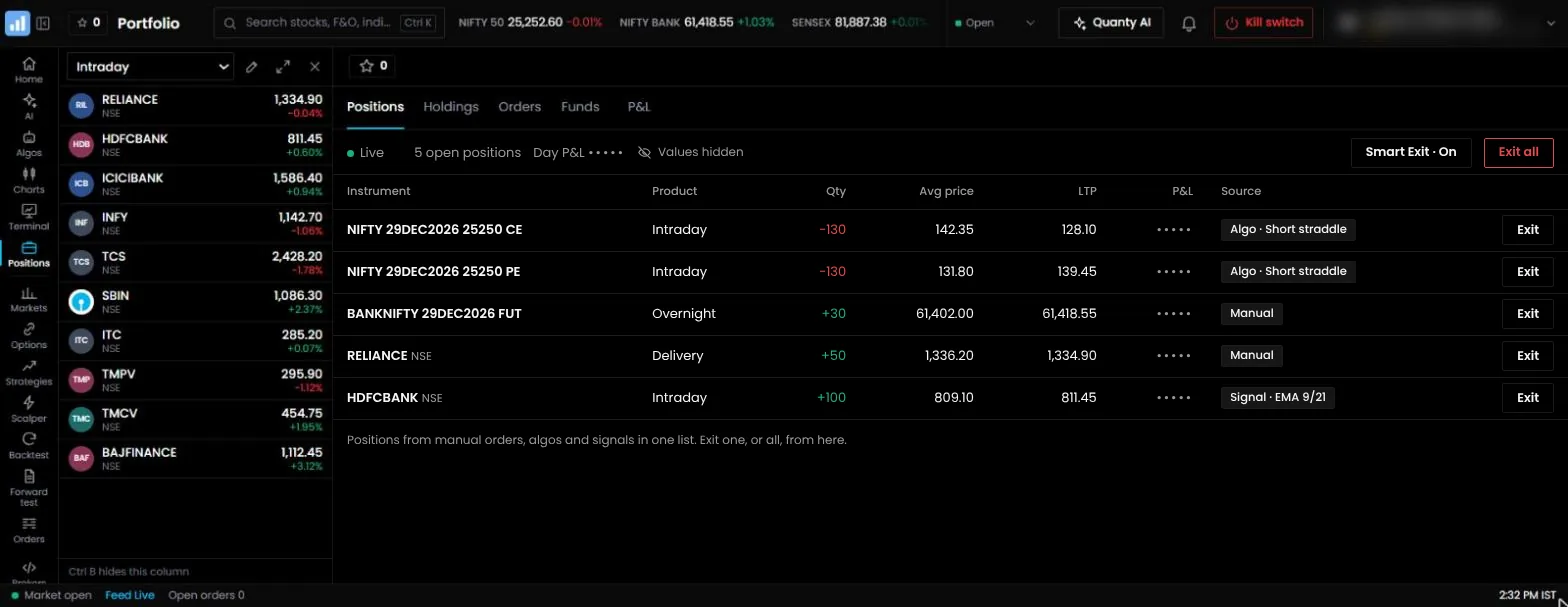
A ₹1 lakh share trade bought and sold the same day costs about ₹83 in charges at the example rates; held overnight as delivery and sold later, the same trade costs about ₹248. The difference is almost all STT and stamp duty. Intraday equity pays STT of 0.025% on the sell side only; delivery pays 0.1% on both the buy and the sell, and stamp duty of 0.015% on the buy instead of 0.003%. Selling delivery shares also adds the DP charge, per company per day. Against that, many brokers charge no brokerage on delivery. For a long-term holding, the charges are small next to the gain; for a trade held one night, they are a real part of the cost.
When the percentage cap matters
For brokers that charge a percentage capped at ₹20, small orders cost less than ₹20 and large orders cost exactly ₹20.
| Order value | 0.03% of the value | Brokerage charged |
|---|---|---|
| ₹10,000 | ₹3 | ₹3 |
| ₹50,000 | ₹15 | ₹15 |
| ₹66,667 | ₹20 | ₹20 |
| ₹16,25,000 (1 lot of Nifty futures) | ₹487.50 | ₹20 |
Above about ₹66,667 per order, a 0.03% plan costs the same as a ₹20 flat fee. Option orders are usually charged a flat ₹20, because a percentage of the premium would be very small.
What charges cost an active or algo trader
A trader who makes 10 option round trips a day for 22 trading days places 440 orders a month. At ₹20 per order, the charges on the one-lot example come to ₹14,049 a month, of which ₹8,800 is brokerage and ₹1,584 is GST on that brokerage. Set your own round trips a day in the brokerage calculator to see the figure for your trading.
Algo strategies with several legs, stop losses and re-entries place more orders than manual trading, so the plan you choose matters more once you automate. Include these charges in your results when you backtest trading strategies: a rule that makes ₹1 a unit per trade on one lot of options barely covers its costs. QuantPower does not charge brokerage. It is priced in tokens (1 token = ₹1, GST extra): a live algo costs 200 tokens per 28 days with orders unlimited inside it, and charts, the option chain and the strategy builder are free; see pricing. Your broker charges brokerage on the orders placed in your account, as on any order.
Other charges to check
- DP charges when you sell shares from your demat account, charged per company per day.
- Account maintenance charges for the demat account, charged yearly or quarterly.
- Call and trade fees for orders placed by phone.
- Interest on margin trading or on a debit balance.
- API charges. Some brokers charge a monthly fee for API access or for live and historical market data through their API; others offer them free. Check your broker's API page before you automate.
The break-even move
Every trade has to move by a certain amount before it makes anything. The calculator works it out as the total charges divided by the quantity, in rupees per unit for options and shares and in points for futures.
The break-even move falls as the order gets larger, because the brokerage is fixed per order while the quantity grows. The same Nifty option round trip, ₹100 to ₹110, in one order each way:
| Lots per order | Total charges | Break-even move per unit | Charges as a share of gross profit |
|---|---|---|---|
| 1 | ₹63.86 | ₹0.98 | 9.8% |
| 2 | ₹80.52 | ₹0.62 | 6.2% |
| 5 | ₹130.49 | ₹0.40 | 4.0% |
| 10 | ₹213.79 | ₹0.33 | 3.3% |
| 1, at a broker with no brokerage on options | ₹16.66 | ₹0.26 | 2.6% |
The last row shows the floor: the statutory charges alone, which no broker can remove. For a strategy that aims at small moves, compare its usual target with the break-even move. A target only two or three times the break-even leaves little room for slippage and losing trades.
Charges and your strategy's numbers
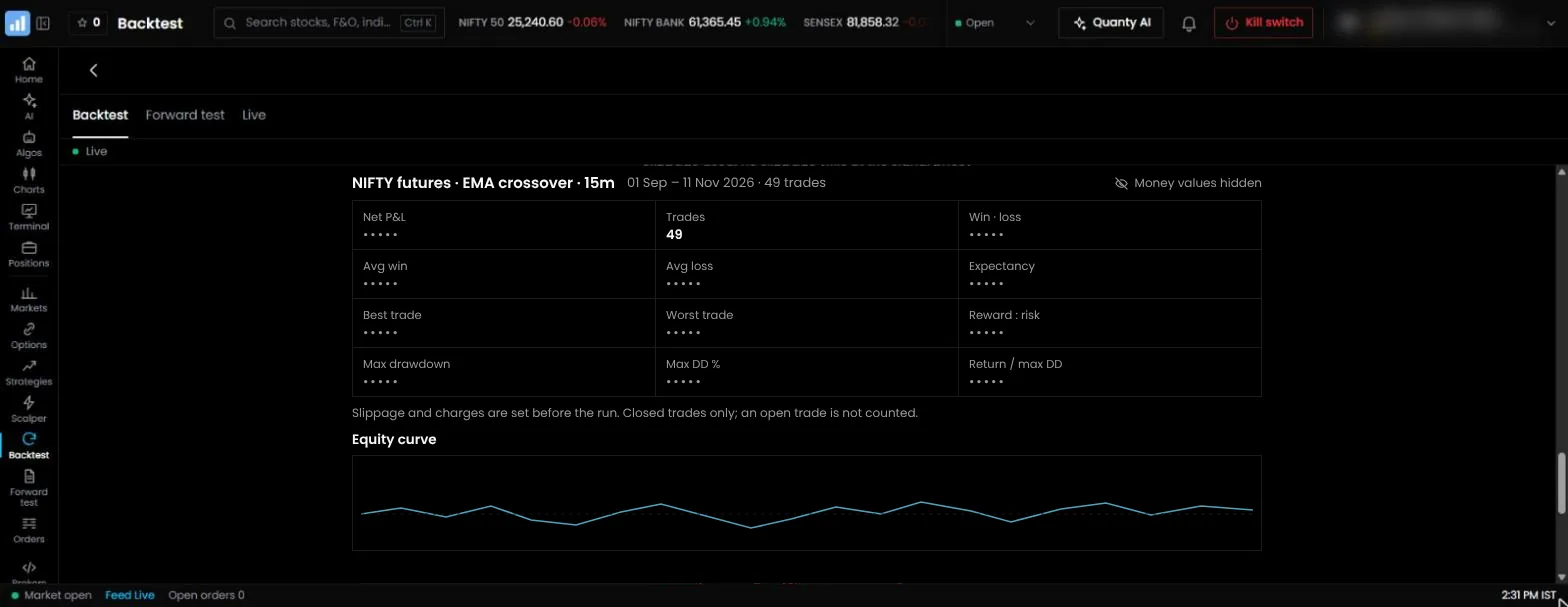
Charges change a strategy's numbers in ways a gross backtest hides:
- The win rate falls. Trades that made a few rupees gross become small losses after charges.
- The average win shrinks and the average loss grows, by the charges on each.
- The best settings move. A tighter stop that looked better gross may look worse net, because it trades more often.
That is why a backtest should always be read after costs. QuantPower's backtests deduct brokerage at the rate you set, STT, exchange charges, the SEBI fee, stamp duty and GST from every trade, and show net, gross and charges side by side.
How to cut your trading costs

You cannot change the statutory charges, but you can change how much of them, and of brokerage, each rupee of profit carries.
- Trade fewer, larger orders. A flat fee per order is the same for one lot and five. Five lots in one order cost far less per unit than five orders of one lot.
- Avoid tiny targets. A scalp that aims for ₹2 on an option priced at ₹100 hands half its profit to charges. Know the break-even move before you place the trade.
- Count the legs. A four-leg strategy entered and exited daily is eight orders a day. A two-leg version of the same idea halves the order count.
- Use limit orders where you can. Charges are fixed, but slippage is not; a market order in a thin strike can cost more than all the charges together.
- Pick the plan for your trading. A broker with free delivery suits a long-term investor; one with a lower per-order fee, or an unlimited plan, suits a trader who places hundreds of orders a month.
- Check the exchange. Futures on BSE carry no transaction charge at the time of writing, and option charges differ between NSE and BSE.
- Review a month at a time. Add up a month's contract notes and compare the charges with the month's gross profit. If charges take more than a third of it, the strategy, the order size or the broker plan needs another look before the next month.
Reading a contract note
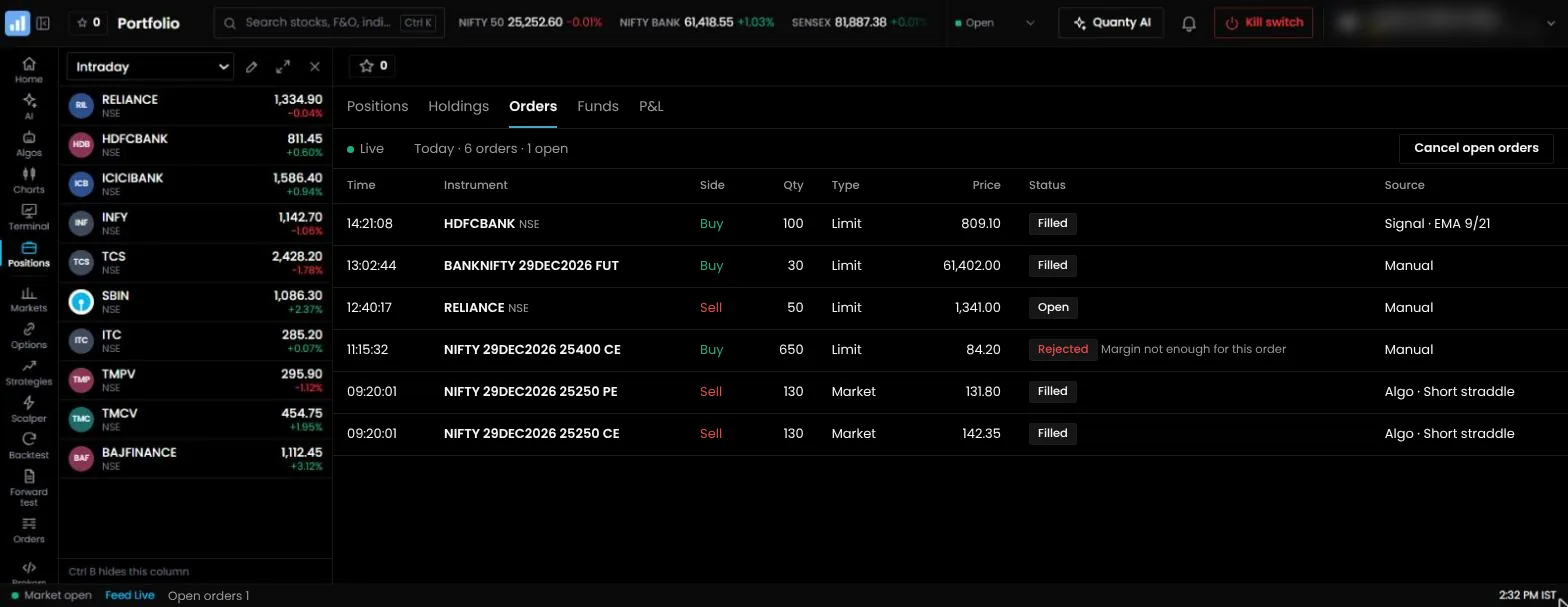
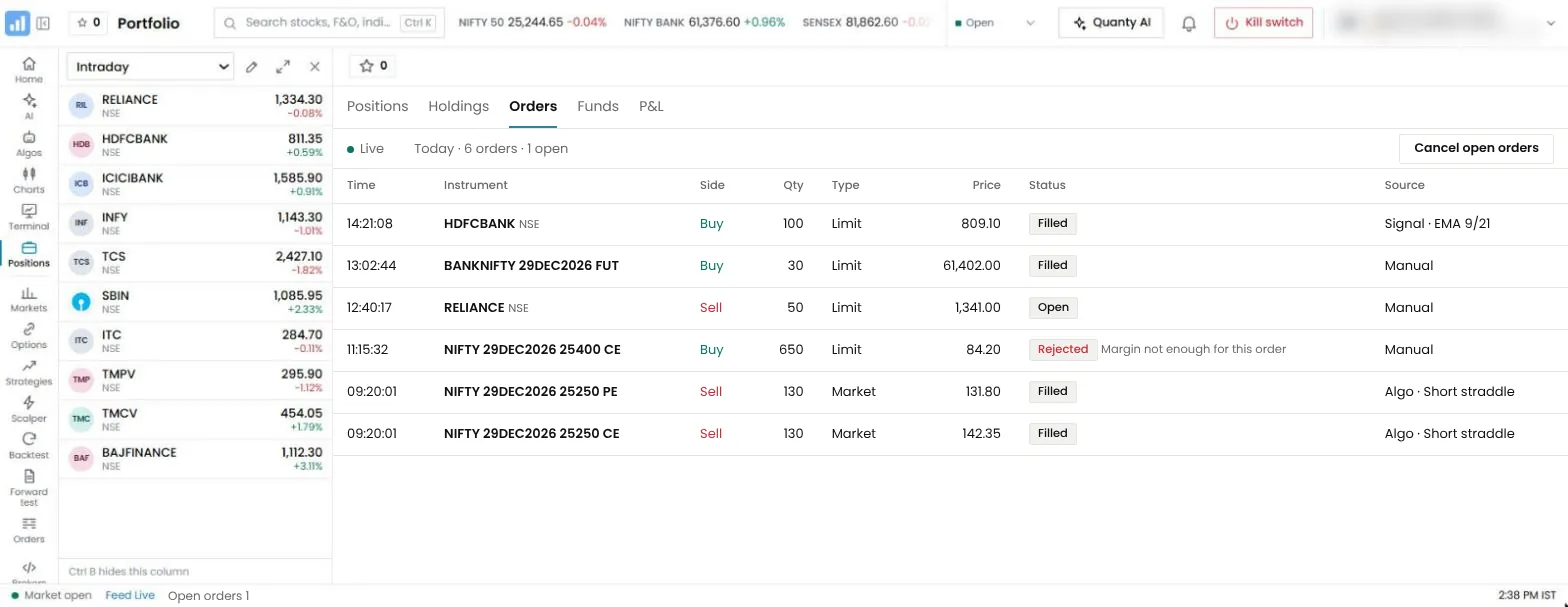
Your broker sends a contract note after every trading day. It is the legal record of your trades and their charges, and it is worth checking against the calculator now and then.
| Line on the note | What to check |
|---|---|
| Trade details | Time, quantity, price and exchange of each fill |
| Brokerage | Per executed order, matching your plan |
| Exchange transaction charges | A percentage of turnover, sometimes shown with the investor protection fund charge |
| STT | On the sell side for F&O, on both sides for delivery |
| SEBI fee | ₹10 per crore of turnover |
| Stamp duty | On the buy side only |
| GST | On brokerage, exchange charges and the SEBI fee, not on STT or stamp duty |
| Net amount | What you pay or receive for the day |
If the note shows more brokerage than you expected, the usual cause is more executed orders than you counted: a partly filled order that was modified and filled again later, or orders placed by an algo's re-entries.
A worked month for an algo trader
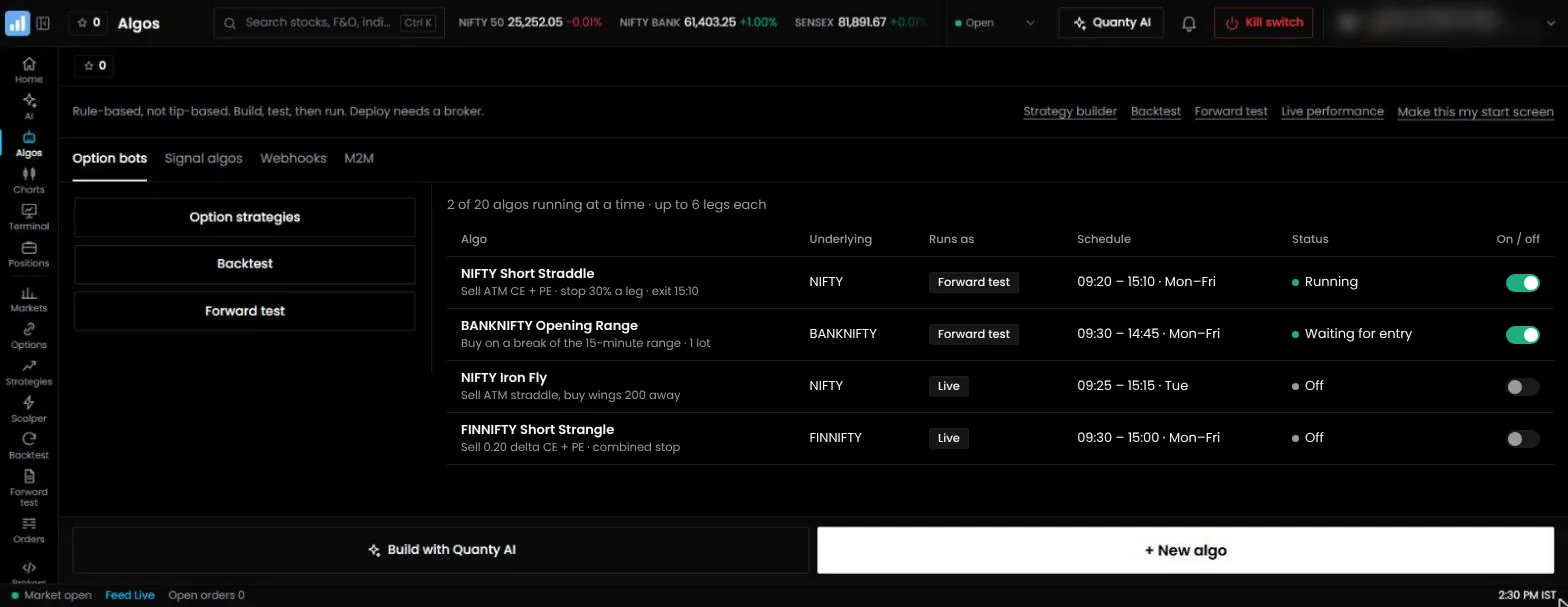
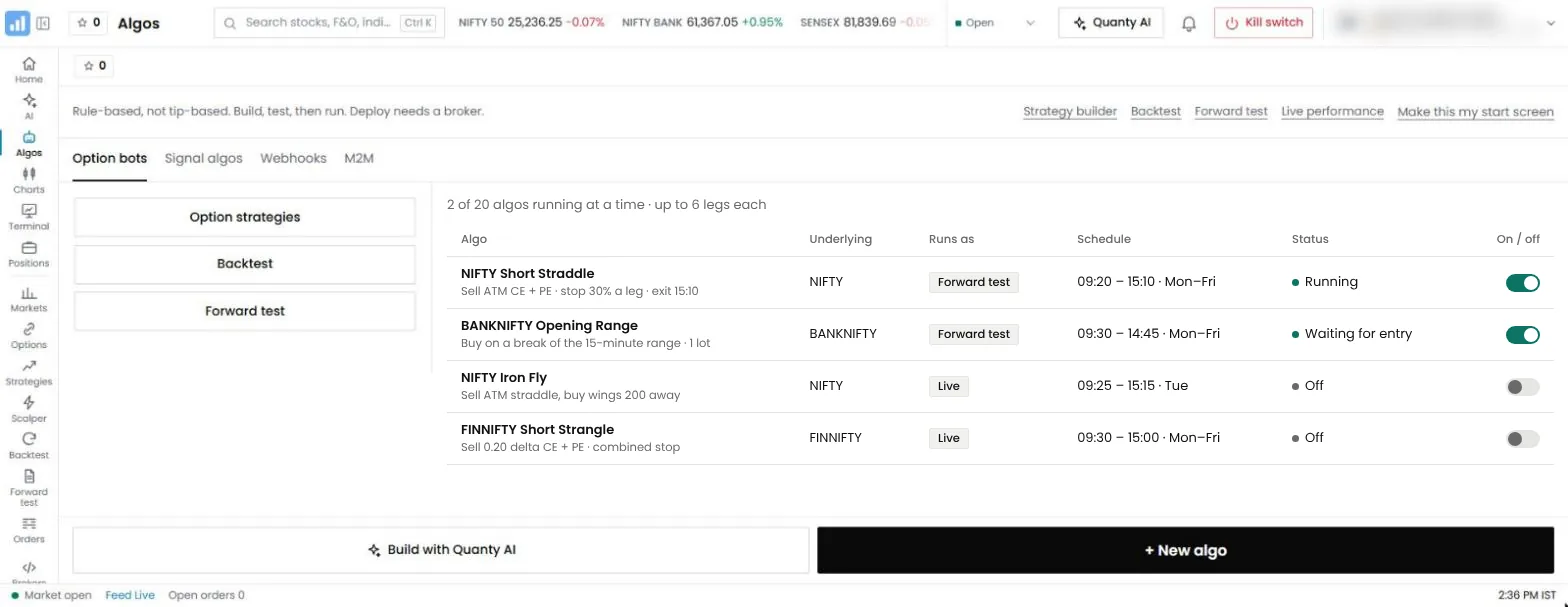
A trader runs two algos on Nifty options, one lot each, at a ₹20-per-order broker: a daily short straddle that enters and exits two legs every day, and a weekly iron condor with four legs opened and closed once a week. Over a month of 21 trading days and four weeks:
| Algo | Orders a month | Brokerage | GST on brokerage |
|---|---|---|---|
| Daily straddle, 4 orders a day | 84 | ₹1,680 | ₹302 |
| Weekly condor, 8 orders a week | 32 | ₹640 | ₹115 |
| Total | 116 | ₹2,320 | ₹417 |
On top of that come STT, exchange charges, the SEBI fee and stamp duty, which depend on the premiums traded. Re-entries after stops add orders, often on the worst days. The software is a separate cost: on QuantPower, two live algos cost 400 tokens per 28 days, whatever the number of orders. For many option traders the broker's charges are the larger of the two.
Common mistakes with trading costs
- Looking only at brokerage. In futures, STT is most of the cost since April 2026.
- Forgetting GST. It adds 18% to brokerage and exchange charges.
- Counting trades, not orders. A round trip is two orders; a four-leg strategy is eight.
- Ignoring slippage. It is not on the contract note, but it is a cost.
- Comparing plans without your own numbers. The cheapest broker for one trader can be the dearest for another.
Income tax on trading profits is separate from these charges; see F&O taxation India.
Start with 500 free tokens
Connect your broker, build a strategy and test it on paper before a single live order goes out.
Frequently asked questions
How is brokerage calculated on an options trade?
Most brokers charge a flat fee per executed order, usually ₹20, whatever the premium or the number of lots. A buy and a sell are two orders, so a round trip costs ₹40 plus 18% GST. The statutory charges are then worked out on the premium turnover.
Is brokerage charged on both buy and sell?
Yes. Each executed order is charged separately, so a buy and a sell cost two brokerage fees.
Which broker has the lowest brokerage for options?
Most of QuantPower's partner brokers charge ₹20 per option order on their standard plans, and some offer other plans. The cheapest choice depends on how many orders you place, so compare the brokers in the calculator with your own number of round trips.
Are statutory charges the same at every broker?
Yes. STT, exchange transaction charges, the SEBI fee, stamp duty and GST are set outside the broker, although brokers may show the transaction charges with slightly different rounding.
Why does my contract note differ slightly from the brokerage calculator?
Contract notes round some charges per order or per day, may show the investor protection fund charge separately from the transaction charges, and add DP charges and any plan fees. Differences of a few paise to a few rupees are normal. A larger difference usually means a different quantity, lot size or exchange.
Does a partly filled order count as one order?
At most brokers, yes: an order that fills in several parts on the same day is charged as one executed order. An order that is rejected, or cancelled before any part fills, costs no brokerage.
What is the break-even move on a trade?
It is the total charges for the round trip divided by the quantity: how far the price must move in your favour before the trade makes anything. For one lot of a Nifty option bought at ₹100 and sold at ₹110 through a ₹20-per-order broker it is ₹0.98 a unit; for one lot of Nifty futures it is about 15 points.
Do charges apply to trades in my Forward test?
A Forward test places no real orders, so no broker charges anything. QuantPower's backtests and Forward test reports still estimate the charges each trade would have paid, so the results are comparable with live trading.
How much STT do I pay on options after April 2026?
STT is 0.15% of the premium on the sell side. Selling one lot of 65 at ₹110 pays ₹10.73. If a bought option is exercised at expiry, STT is 0.15% of its intrinsic value.
Related guides
- STT tax calculator: the statutory charges alone, without brokerage
- Stock profit calculator: the profit on a holding after charges and tax
- Option profit calculator: the payoff of an options position at expiry
References
- NSE, history of the exchange: screen-based trading in equities from November 1994 (nseindia.com)
- Finance (No. 2) Act, 2004: securities transaction tax from 1 October 2004; Finance Act, 2026 and the Union Budget 2026-27: STT on futures and options from 1 April 2026 (indiabudget.gov.in)
- Indian Stamp Act, as amended by the Finance Act, 2019: uniform stamp duty on securities transactions from 1 July 2020 (egazette.gov.in)
- SEBI, circular on charges levied by market infrastructure institutions ("true to label"), effective 1 October 2024 (sebi.gov.in)
- NSE and BSE: transaction charges for equity, futures and options (nseindia.com, bseindia.com)
- Zerodha, Upstox, Fyers, IIFL Capital and Wisdom Capital: published brokerage pages (checked 10 October 2026)