For example, one lot of Nifty futures at 25,000 is a ₹16,25,000 contract. At 9% SPAN and 2% exposure margin it needs about ₹1,78,750, and a 1% move against you costs ₹16,250, or 9% of that margin, in a single day. The calculator shows that chain from contract value to margin to the daily loss, so you can see not only what a position blocks but what it can take from your account. Its rates are typical levels, not the exchange's live SPAN figures, so use it to plan and your broker's figure to trade.
How to use the F&O margin calculator
- Choose the contract: Nifty, Bank Nifty or a stock. The price, lot size and typical margin rates fill in.
- Choose the position: futures, sell an option or buy an option.
- For a sold index option, choose a normal day or expiry day. On expiry day an extra 2% exposure margin applies.
- Check the SPAN and exposure margin rates. The defaults are typical levels for October 2026. Replace them with the rates your broker shows if you know them.
- Enter the number of lots and your capital to see how much of the account the position takes.
The lot size is the number of units in one contract. For what margin is and why brokers collect it, see what is margin in trading.
A short history of margin in futures and options
Margin is as old as futures exchanges. When the Chicago Board of Trade standardised grain contracts in the 1860s, it also had to make sure that a trader who lost money would pay; a deposit held against each open contract, topped up as prices moved, was the answer.1 Daily settlement of profits and losses, with the deposit as a buffer for one day's move, is still how futures margin works.
Options brought a harder problem, because the loss on a sold option depends on how far and how fast the price moves and on volatility. In 1988 the Chicago Mercantile Exchange introduced SPAN, the Standard Portfolio Analysis of Risk, which works out the margin for a whole portfolio by revaluing it under a set of price and volatility scenarios and taking the worst loss.1 SPAN became the standard method at derivatives exchanges around the world.
India adopted SPAN from the start of its equity derivatives market. NSE's clearing corporation has margined index futures since June 2000 and options since 2001 on a SPAN-based system, with an exposure margin on top.2 The rules have tightened in steps since then. From December 2020 SEBI phased in peak margin, so that brokers must collect the full margin on intraday positions as well as overnight ones, at 100% from September 2021.3 On 1 October 2024 SEBI announced further measures for index derivatives, including an extra 2% exposure margin on short options on their expiry day, no calendar spread benefit on expiry day, and option premium collected upfront from buyers.4 Each step raised the margin a trader needs for the same position, and made it more important to know the figure before placing a trade.
How F&O margin is calculated
| Part of the margin | What it covers | Set by |
|---|---|---|
| SPAN margin | The largest one-day loss the position could suffer across the exchange's price and volatility scenarios | NSE Clearing or Indian Clearing Corporation, updated several times a day |
| Exposure margin | A buffer on top of SPAN: 2% of contract value for index F&O, 3.5% or more for stock F&O | The exchange |
| Extra exposure margin on expiry day | 2% of contract value on short index options that expire that day | SEBI rule, from 20 November 2024 |
| Premium | Paid in full by an option buyer, who needs no SPAN or exposure margin | Collected upfront since February 2025 |
Your broker must collect at least the exchange margin before the order goes out. It can ask for more than the exchange minimum, never less.
Margin for one lot at typical rates
The figures below are the calculator's defaults. The rates are assumptions chosen to sit inside the range brokers showed in October 2026, about 10% to 15% of contract value for Nifty futures and short options.
| Position | Contract value | Rates used | Margin |
|---|---|---|---|
| Nifty futures, 25,000 × 65 | ₹16,25,000 | 9% SPAN + 2% exposure | ₹1,78,750 |
| Sell a Nifty at-the-money option, normal day | ₹16,25,000 | 7% + 2% | ₹1,46,250 |
| The same option on its expiry day | ₹16,25,000 | 7% + 2% + 2% | ₹1,78,750 |
| Buy a Nifty 25,000 call at ₹280 | ₹16,25,000 | Premium only | ₹18,200 |
| Bank Nifty futures, 56,000 × 30 | ₹16,80,000 | 8% + 2% | ₹1,68,000 |
| Sell a Bank Nifty at-the-money option | ₹16,80,000 | 6.5% + 2% | ₹1,42,800 |
| Stock futures, ₹1,400 × 500 | ₹7,00,000 | 15% + 3.5% | ₹1,29,500 |
Leverage is the contract value divided by the margin. The Nifty futures lot above has leverage of 9.1×, the short Nifty option 11.1× and the stock future 5.4×. Leverage multiplies a move in the price into a much larger move in your account.
Option selling margin calculator

Selling an option needs margin because the seller's loss has no fixed limit. The buyer of the same option pays only the premium, which is the most a buyer can lose. Use the calculator as an option selling margin calculator by choosing Sell an option: it adds the SPAN and exposure parts and, for index options, the extra margin on expiry day.
SPAN for a sold option depends on how far it is from the money and how volatile the market is. An at-the-money option needs more than a far out-of-the-money one, and margins rise when volatility rises. The table shows the margin on one lot of a sold Nifty option at different SPAN rates.
| SPAN rate | Normal day | Expiry day |
|---|---|---|
| 5% | ₹1,13,750 | ₹1,46,250 |
| 6% | ₹1,30,000 | ₹1,62,500 |
| 7% | ₹1,46,250 | ₹1,78,750 |
| 8% | ₹1,62,500 | ₹1,95,000 |
| 10% | ₹1,95,000 | ₹2,27,500 |
Two sold options are margined as a portfolio, so a short straddle needs less than two separate short legs: about ₹2 lakh to ₹2.4 lakh a lot. Buying a further out-of-the-money option against a sold one caps the loss and cuts the margin sharply.
How a SPAN margin calculator works
SPAN (Standard Portfolio Analysis of Risk) revalues your whole F&O portfolio under 16 scenarios of price and volatility change and takes the worst loss as the SPAN margin. The price scan range sets how far the price moves in those scenarios. When volatility rises, the clearing corporation widens the scan range, and the margin on positions you already hold rises with it, sometimes during the session.
A SPAN margin calculator, such as the one on your broker's website, reads the clearing corporation's latest SPAN file and runs those scenarios on the exact contracts you enter. That is why it gives the exact figure for a spread, a straddle or a basket of legs. This calculator does not read the SPAN file. It applies the percentages you set to the contract value, which is quick for one position and shows the leverage and mark-to-market risk, but treats every position as unhedged.
Exposure margin is added on top of SPAN. For index futures and options it is 2% of contract value. For stock F&O it is the higher of 3.5% and 1.5 times the stock's volatility, so volatile stocks need more.
Zerodha margin calculator
Zerodha's margin calculator on its website uses the latest SPAN file. You add contracts, including several legs together, and it shows the SPAN, exposure and total margin, with the benefit for hedged legs. Kite also shows the required margin in the order window before you place an order. Use it, or the equivalent at Upstox, Fyers, IIFL Capital or Wisdom Capital, for the exact figure on the day you trade.
Use this calculator alongside it to see what the margin means for your account: the share of your capital it takes, how many lots your capital covers and how far the price can move before a loss eats into the margin.
Futures margin and daily losses

Futures profits and losses are settled in cash every day, so the margin is not the most you can lose. It is a deposit that the exchange expects to cover about a day's loss. The calculator shows what a move against one lot of Nifty futures costs.
| Move against you | Nifty points | Loss on one lot | Share of the ₹1,78,750 margin |
|---|---|---|---|
| 1% | 250 | ₹16,250 | 9% |
| 2% | 500 | ₹32,500 | 18% |
| 3% | 750 | ₹48,750 | 27% |
| 5% | 1,250 | ₹81,250 | 45% |
If losses take the account below the margin required, the broker asks for more funds or closes the position. Keep money in the account above the margin for these losses.
Rules that change the margin you need
- Full margin for intraday positions. Since September 2021, brokers must collect the full SPAN and exposure margin for intraday F&O positions, the same as for positions carried overnight.
- Extra margin on expiry day. Since 20 November 2024, short index options expiring that day carry an extra 2% exposure margin.
- No calendar spread benefit on expiry day. Since 1 February 2025, positions in contracts expiring that day get no margin offset against other expiries.
- Premium collected upfront. Since February 2025, option buyers pay the full premium before the order is placed.
- Cash and collateral. Brokers require at least half the margin in cash or cash equivalents. The rest can come from shares you pledge, after a haircut.
Checks before you trade
- Check the exact figure in your broker's margin calculator on the day, because SPAN changes during the session.
- Place the bought leg of a hedge before the sold leg, or the broker blocks the full margin of the short leg first.
- Keep funds above the margin for daily losses, and more before events such as the RBI policy, the Budget or US data.
- On expiry morning, check free margin before the open: a sold option that fitted yesterday may not fit today.
- Size the position by the loss you accept, not by the margin you have; the position size calculator does that.
Margin for spreads and hedges

The calculator treats each position on its own. SPAN treats your portfolio as a whole, so a hedge lowers the margin, often sharply.
| Position | How SPAN sees it | Effect on margin |
|---|---|---|
| Short straddle | Two short options whose worst losses come in opposite moves | Less than two short legs margined separately |
| Short strangle with bought wings (iron condor) | The bought options cap the loss on both sides | Much less than the naked strangle; close to the maximum loss |
| Bull call spread | A bought call with a sold call above it | The sold call needs little or no extra margin beyond the debit paid |
| Futures with a bought put | The put caps the loss on the long future | Lower than the future alone |
| Calendar spread | A sold near-month option against a bought far-month one | Offset, except on the expiry day of the near leg |
The order of the legs matters. If you place the sold leg first, the broker blocks the full margin of a naked short until the hedge fills. Place the bought leg first. QuantPower's algos and baskets do this on their own: buy legs go first and sell legs only after the buys have filled. For the margin saved by a wing, see hedge margin benefit.
Margin from pledged shares

Shares you already hold can count towards F&O margin. You pledge them through your broker and the depository, and the clearing corporation gives you collateral worth their value less a haircut. The haircut depends on the stock's risk; for large, liquid shares it is often around 10% to 20%.
Pledged shares stay yours, with their dividends, and you can unpledge them when the position is closed. A sharp fall in the pledged shares lowers the collateral, at the same time as a fall in the market may raise the margin on a short put. In QuantPower, the Holdings screen lets you pledge a holding, and the Funds screen shows margin, collateral and cash from your broker. The guide to pledging shares for margin covers the steps.
Margin for option buyers and option sellers, side by side
| Option buyer | Option seller | |
|---|---|---|
| Pays upfront | The full premium | SPAN plus exposure margin, plus the expiry-day extra on index options |
| Most that can be lost | The premium paid | No fixed limit unless hedged |
| Margin changes with volatility | No | Yes, rises when volatility rises |
| Receives | Nothing upfront | The premium, which can count towards margin |
| Typical one-lot Nifty figure at the defaults above | ₹18,200 for a ₹280 call | ₹1,46,250 on a normal day |
The gap between the two figures is why many new traders start by buying options: the cost of entry is small. It is not a measure of the odds or of the risk to the account. A buyer can lose the whole premium on most trades; a seller collects small amounts often and can lose large amounts rarely. The margin only tells you what each side must put down.
Commodity and currency margin
Commodity futures on MCX and currency futures on NSE and BSE use the same SPAN approach, with their own scan ranges and exposure rates. Commodity margins change with the commodity's volatility and can rise in the run-up to a contract's delivery period; a bullion or crude oil contract that fitted comfortably at the start of the month may need noticeably more near expiry. The calculator's futures mode works for them if you enter the contract value and the rates your broker shows.
Margin and the size of a position
The margin is what the broker blocks. It is not the risk. Two positions with the same margin can have very different worst days: a short straddle with ₹2 lakh of margin can lose more than ₹2 lakh on a gap, while an iron condor with ₹1 lakh of margin cannot lose more than its defined maximum.
Size a position from the loss you accept, then check that the margin fits:
- Decide the most you will lose on this trade, for example 2% of the account.
- Work out the loss per lot at your stop, from the chart or the payoff.
- Divide the first by the second to get the number of lots; the position size calculator does this.
- Check the margin for that many lots in the calculator, and keep a cash buffer above it for daily losses.
If the margin for the lots your risk allows is more than your account can carry, trade fewer lots or a hedged structure, not a larger stop.
A worked example: a short strangle through expiry week
A trader with ₹6,00,000 in his account plans to sell one lot of a Nifty strangle, the 25,500 call and the 24,500 put, with Nifty at 25,000 and a lot of 65.
- Monday. His broker's SPAN calculator shows about ₹1.9 lakh for the pair, less than two naked short options margined separately because the two legs lose in opposite moves. He places the trade with about a third of the account blocked.
- Tuesday. Volatility rises after weak global markets. The clearing corporation widens its scan range during the session and the margin on his open strangle rises to about ₹2.2 lakh. Nothing is sold; his free cash simply shrinks.
- The day before expiry. He checks free margin after the close. The next morning both legs will carry the extra 2% exposure margin on their own contract value, roughly ₹32,500 a leg at these assumptions, so the pair will need around ₹65,000 more.
- Expiry morning. Because he left a buffer, the higher margin fits. A trader who had used ₹5.5 lakh of the same account for three strangles would have been short on the open, and his broker could have cut his positions at the worst prices of the day.
The figures in this example are illustrations, not the exchange's SPAN numbers. The lesson is in the steps: margin changes during the week, rises on expiry day, and should be checked before the open, not after the broker's call.
Margin shortfall and penalties
If the margin your positions need is more than what your account holds, the broker first asks you to add funds or reduces the position. If the shortfall reaches the clearing corporation, which collects margin from brokers at several points in the day, the exchange charges a penalty on the amount short, and brokers pass it on to the client who caused it. The penalty is a percentage of the shortfall per day, higher for larger shortfalls and for shortfalls that repeat. A shortfall can arise without any new trade: a rise in SPAN on positions you already hold, or a fall in the value of pledged shares, is enough. A buffer of free cash is the simplest protection.
Reading your broker's margin screen
Every broker shows margin in its own words, but the same few figures appear:
| Figure | What it means |
|---|---|
| Total margin or available margin | Cash plus collateral from pledged shares, less what is already in use |
| Used margin or utilised | SPAN, exposure and premium blocked by your open positions and orders |
| SPAN and exposure | The two parts of the F&O margin on your positions |
| Collateral | The value of pledged shares after the haircut |
| Withdrawable | Cash you can take out today; usually less than free margin, because collateral cannot be withdrawn as cash |
| M2M | Today's unrealised profit or loss on open positions, which changes free margin through the day |
Read three of them before every F&O trade: available margin, the margin the new trade needs, and what will be left as a buffer. A buffer of a fifth to a third of the blocked margin is a common habit among option sellers; the right size depends on how far the market can move against your positions in a day.
Where margin rules are going
The direction since 2020 has been steady: more margin, collected earlier, checked more often. Peak margin brought intraday positions under full margin; the 2024 measures added expiry-day margin and took away the expiry-day calendar offset; and from April 2025 exchanges began checking position limits in index derivatives during the day, not only at the close.4 For a trader, the practical effect is that the margin figure is no longer something to look up once in the morning. It moves with volatility, with the calendar and with every position you add, and the trader who checks it before each trade, and keeps a buffer above it, is the one who is never surprised by a call from the broker.
Margin in QuantPower
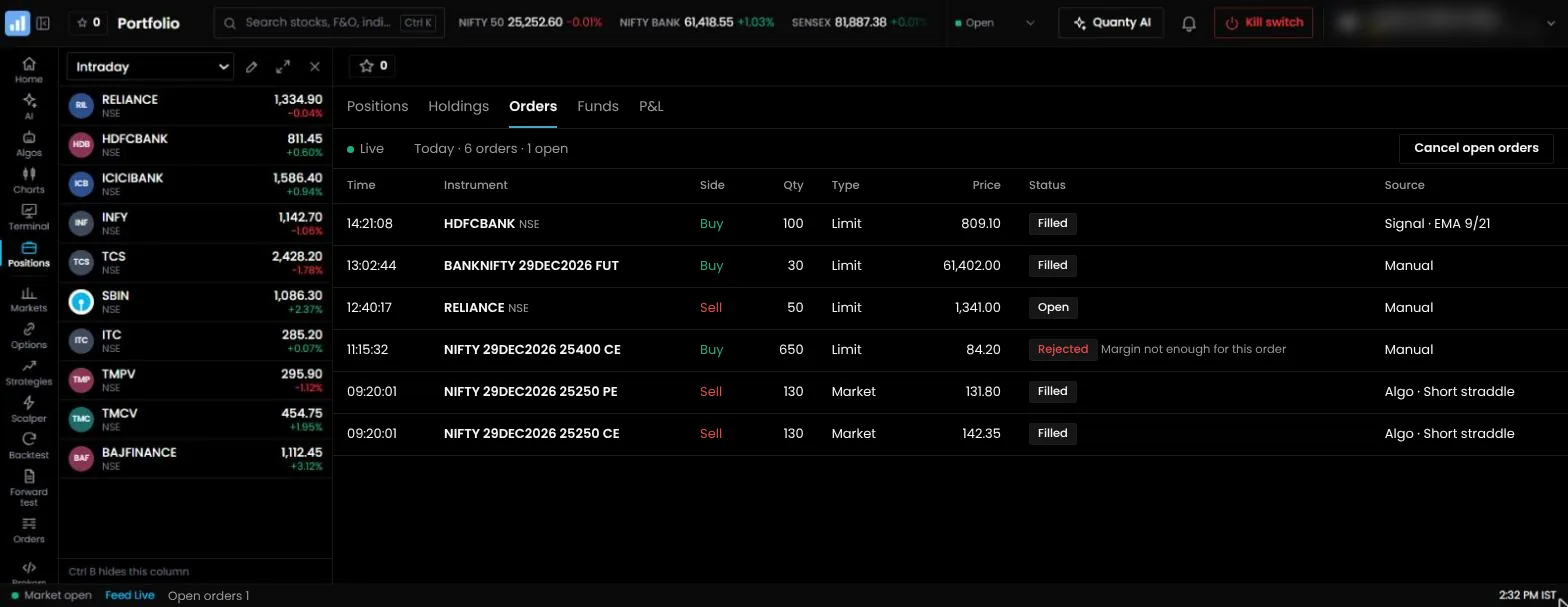
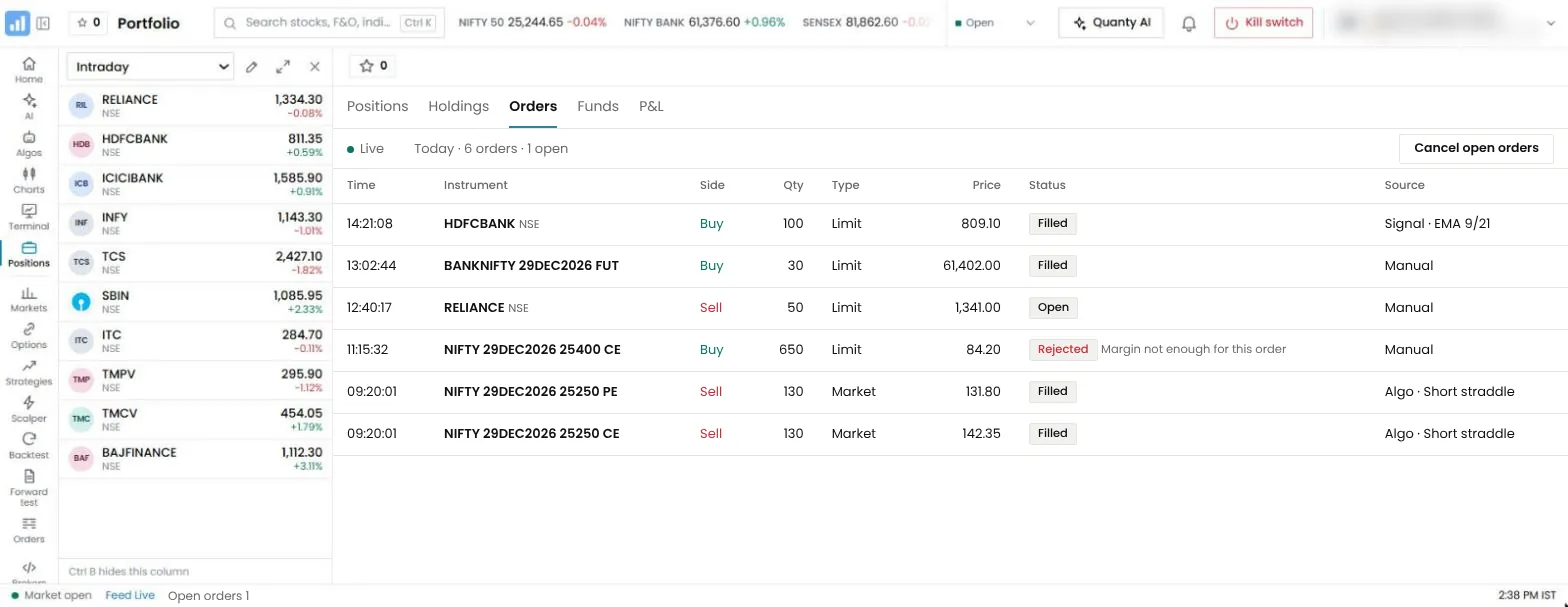
When you trade through QuantPower, the margin shown before the order comes from your connected broker account, so it matches what the broker will block. The order sheet shows the margin preview before you confirm, the strategy builder shows the margin for a whole set of legs as you build it, and the Funds screen shows margin used, collateral, cash and what can be withdrawn, broker by broker. The margin calculator on this page is free, as are charts, the option chain and the strategy builder; tokens pay for running algos. See pricing.
Common margin mistakes
- Using all the margin you have. A position that takes 90% of the account's margin leaves no room for a day's loss or a rise in SPAN.
- Forgetting expiry day. The extra 2% and the loss of the calendar spread benefit can push a position over the limit on the morning it expires.
- Selling first, hedging second. The broker blocks the naked margin until the hedge fills.
- Reading margin as the maximum loss. For futures and sold options, the loss can be larger than the margin.
- Ignoring events. SPAN widens when volatility rises, often just before or after a policy announcement, a Budget or an election result.
Start with 500 free tokens
Connect your broker, build a strategy and test it on paper before a single live order goes out.
Frequently asked questions
How is F&O margin calculated?
The clearing corporation works out SPAN margin, the largest one-day loss across its risk scenarios, and the exchange adds exposure margin, 2% of contract value for index F&O. Short index options also carry an extra 2% on their expiry day. Option buyers pay only the premium.
How much margin do I need for one lot of Nifty futures?
About ₹1.6 lakh to ₹2.4 lakh in October 2026, or 10% to 15% of the contract value. At 25,000 and a lot of 65, the contract is worth ₹16,25,000, and 11% of it is ₹1,78,750. Check your broker's figure on the day you trade.
What is the difference between SPAN and exposure margin?
SPAN covers the likely worst one-day loss on your portfolio and changes with volatility and with hedges. Exposure margin is a fixed extra buffer on the contract value, 2% for index F&O and at least 3.5% for stock F&O.
Do I need margin to buy options?
No. A buyer pays the full premium upfront, and that premium is the most the position can lose.
Why did my margin go up during the day?
The clearing corporation updates SPAN several times a session. When volatility rises, the scan range widens and the margin on open positions rises with it.
Is intraday F&O margin lower than overnight margin?
No. Since September 2021, intraday F&O positions need the full SPAN and exposure margin. Intraday positions are squared off before the close, but they need the same margin while they are open.
Why is withdrawable cash lower than my free margin?
Free margin includes collateral from pledged shares, which counts for trading but cannot be paid out as cash. Unrealised profit on open positions may also count for margin before it can be withdrawn.
Does margin differ between brokers?
The exchange sets the minimum, and every broker must collect at least that. A broker may ask for more, for example on volatile stocks or before events, so two brokers can show different figures for the same position.
What happens if my account falls short of margin?
The broker asks you to add funds or reduces the position. If the account is short of the exchange's required margin, the exchange charges a shortfall penalty, which the broker passes on to you.
Related guides
- Option buying vs selling: how the two sides compare on risk and margin
- Futures vs options: how the two differ on margin and risk
- Brokerage calculator: the charges on a round trip
References
- CME Group, SPAN methodology overview, introduced in 1988 (cmegroup.com); history of futures margin and daily settlement
- NSE Clearing, SPAN parameters and exposure margin rules for equity derivatives (nseindia.com)
- SEBI, circulars on peak margin requirements, phased in from December 2020 to September 2021 (sebi.gov.in)
- SEBI, circular "Measures to strengthen Equity Index Derivatives framework for increased investor protection and market stability", 1 October 2024 (sebi.gov.in)
- NSE, revision in market lot of index derivative contracts from the January 2026 series (Nifty 65, Bank Nifty 30) (nseindia.com)
- Broker margin calculators and published margin examples for Nifty and Bank Nifty, checked 17 October 2026