A stock SIP in QuantPower buys one share or ETF, or a basket of several with the amount split between them, weekly or monthly, either for an amount, such as ₹5,000, or for a fixed number of shares. On each due date QuantPower prepares a delivery buy at the market price through your broker. In reminder mode it tells you the instalment is due and you place it with one tap; in auto mode it places the instalment itself a few minutes after the market opens, because you agreed to that when you set the SIP up. A due date that falls on a weekend or a holiday moves to the next trading day, and no due date ever buys twice. Stock SIPs cost no tokens; your broker's charges apply to each instalment as to any order.
What QuantPower's stock SIP does
| Part | What it does |
|---|---|
| What it buys | One share or ETF, or several in one plan, on NSE or BSE, as delivery buys at the market price |
| How much | An amount (whole shares, rounded down) or a fixed number of shares |
| How often | Weekly, on a weekday you choose, or monthly, on a day from 1 to 28 |
| Due dates | Weekends and holidays move to the next trading day; one instalment per due date |
| Reminder mode | You are told on the due day and place the instalment with one tap |
| Auto mode | QuantPower places the instalment itself, 5 minutes after the open |
| Length | A set number of instalments, or until you stop it |
| Funds check | If your broker shows too little money, the instalment is not placed and you are told how much is short |
| Consent record | Every change, every switch to auto and every instalment is recorded with who, when and from which device |
| Your broker | Orders go to the broker you choose; shares land in your own demat account |
| Price | Free: no tokens |
What is SIP in stocks?
SIP stands for systematic investment plan: investing the same amount at fixed intervals, whatever the market is doing. Most investors know it from mutual funds, where a bank mandate buys fund units every month. In a stock SIP, each instalment buys shares or ETF units on NSE or BSE instead, and they are credited to your demat account.
Because the amount is fixed, it buys more units when the price is low and fewer when it is high. This is called rupee cost averaging.
Averaging does not stop the holding from losing value if prices keep falling. It only means you did not put all your money in at one price.
A short history of the SIP
The idea behind a SIP is older than the name. In 1949 Benjamin Graham described "dollar-cost averaging" in *The Intelligent Investor*: put the same sum into shares at regular intervals, so that more shares are bought when prices are low and fewer when they are high, and the investor never has to guess the right moment.1 Graham presented it as a method for the ordinary investor who could not, and should not try to, time the market.
In India the SIP became a household word through mutual funds. Fund houses offered monthly investment plans through the 1990s and 2000s, and electronic bank mandates made them easy to run. The habit grew steadily, and by 2024 Indian investors were putting more than ₹20,000 crore a month into mutual fund SIPs, according to the Association of Mutual Funds in India.2
Stock and ETF SIPs came later, because they depend on cheap online trading. India's first exchange traded fund, tracking the Nifty, was launched at the end of 2001.3 As discount brokers cut the cost of a delivery order to little or nothing, buying a few shares every month stopped being expensive, and brokers began to offer SIPs in shares and ETFs. Settlement also became faster: since January 2023 all Indian shares settle on T+1, the next trading day, so shares bought on a SIP date reach the demat account a day later.4
How a stock SIP works in QuantPower
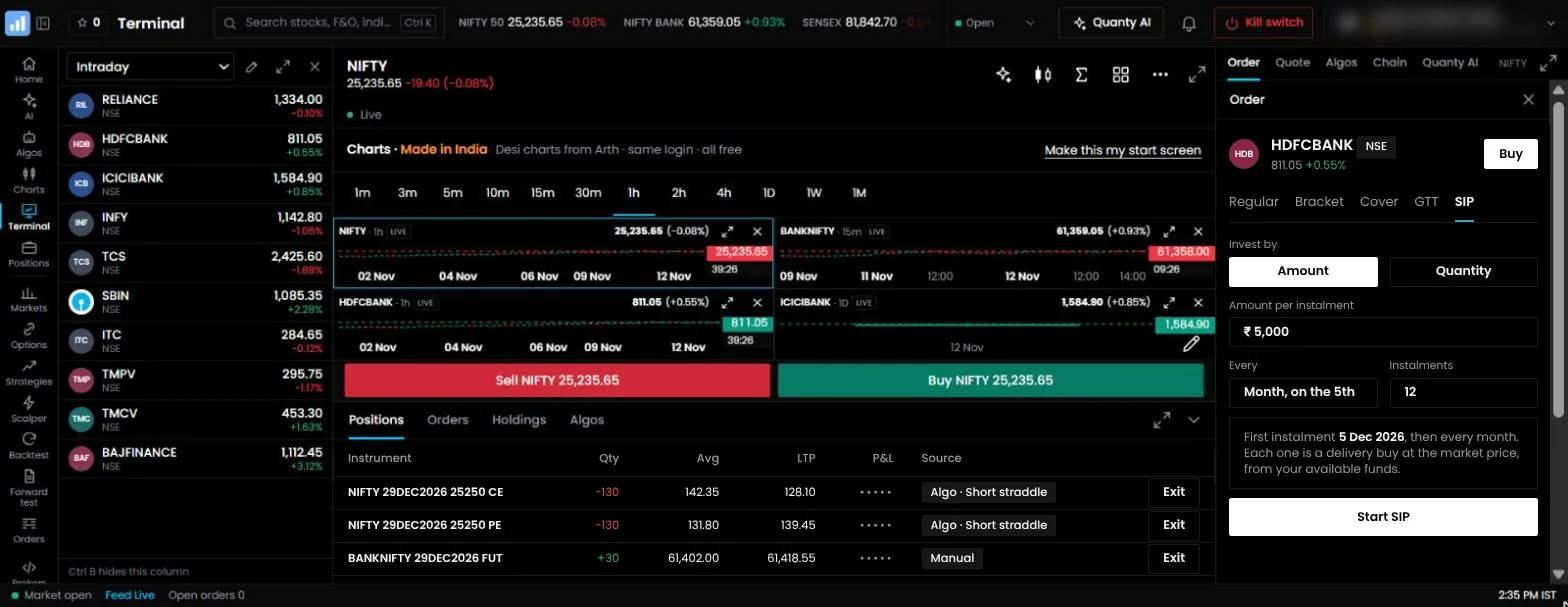
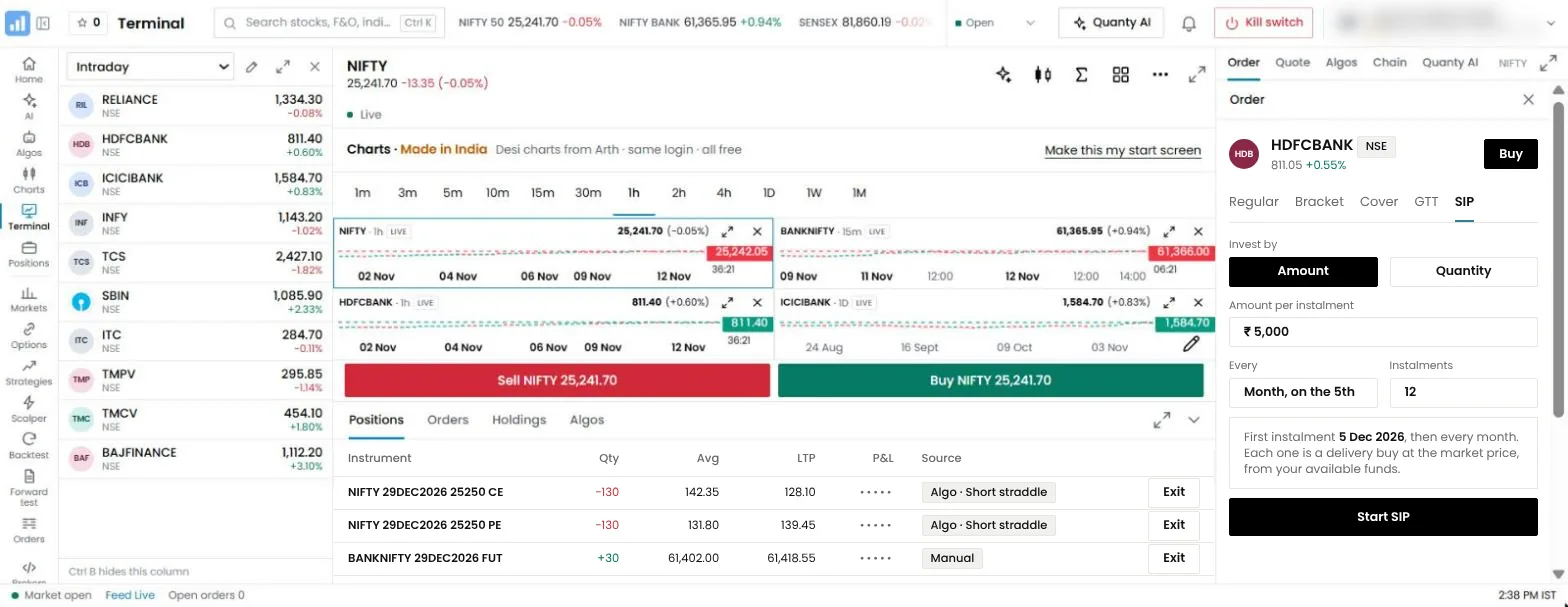
- Choose the shares or ETFs. Search for each as you would for any order. A SIP can hold one, or several in one plan; for several, set each one's share of the amount, such as 40% to a Nifty ETF and 20% each to three shares.
- Choose the size. Either an amount, such as ₹5,000, or a fixed number of shares, such as 10.
- Choose the schedule. Weekly on a day from Monday to Friday, or monthly on a day from 1 to 28. Add a number of instalments if you want it to stop on its own; leave it blank to run until you stop it.
- Choose the broker that should buy, if you have more than one connected.
- Choose the mode: reminder or auto.
- Save it. The SIP shows its next due date.
On the due date:
- The order is prepared. For an amount, QuantPower divides it, or each stock's share of it in a plan of several, by the last price and rounds down to whole shares. For a fixed quantity, it uses that number. Each order is a delivery buy at market price, one for every stock in the plan.
- Your funds are checked at the broker that buys. If the estimated cost is more than the money available, the instalment is not placed, and you are told how much it needs and how much is there.
- In reminder mode, you are told the instalment is due, and you place it with one tap after checking it.
- In auto mode, QuantPower places it itself, 5 minutes after the market opens, through the same order path and checks as any order.
- The shares settle in your demat account on the next trading day.
Reminder mode and auto mode
The two modes differ in one thing: who presses the button on the due day.
| Reminder mode | Auto mode | |
|---|---|---|
| On the due day | You are told the instalment is due | QuantPower places it 5 minutes after the open |
| Your tap | Needed for each instalment | Given once, when you turn auto on |
| Good for | Investors who want to look at each buy | Investors who want the plan to run without them |
| If funds are short | You see it before you place | The instalment is not placed, and you are told |
Turning auto mode on is a decision about future orders, so QuantPower records it: who turned it on, when, from which device and with which action. Each automatic instalment is linked to that record. If you turn auto off, later instalments go back to reminders. The same record covers every change to the SIP and its stop, so there is always a plain answer to "who asked for this order?".
Amount or quantity?
You can size each SIP by an amount or by a number of shares. They behave differently.
| By amount | By quantity | |
|---|---|---|
| Each instalment | Spends up to the amount, in whole shares | Buys the same number of shares |
| When the price falls | Buys more shares | Spends less money |
| When the price rises | Buys fewer shares | Spends more money |
| Rupee cost averaging | Yes | No: you pay the average price |
| Cash you need | Steady and known | Changes with the price |
A SIP by amount is the classic SIP: steady money in, more shares bought when prices are low. A SIP by quantity is a plan to build a holding of a set size, for example 120 shares over a year at 10 a month, whatever they cost. If you choose quantity, keep enough in your trading account for a month when the price is higher than you expect.
Pausing, changing and stopping a SIP
A SIP is active, paused or stopped.
- Pause it to skip instalments for a while, for example during a month you need the cash. No instalment is placed while it is paused. Resume it and it carries on from the next due date.
- Change the amount, the quantity, the schedule or the mode at any time. If you change the frequency or the day, the next due date is worked out again from today.
- Stop it when you no longer want it. A SIP with a set number of instalments stops on its own after the last one.
Every change is recorded with the time, the device and the action that made it, along with the SIP's instalments. Shares already bought stay in your demat account whatever you do to the SIP.
Rupee cost averaging in numbers
Here is a ₹6,000 monthly SIP in an ETF over six months in which the price falls and then recovers. Prices are examples.
| Month | Price | Units bought | Spent |
|---|---|---|---|
| 1 | ₹300 | 20 | ₹6,000 |
| 2 | ₹270 | 22 | ₹5,940 |
| 3 | ₹240 | 25 | ₹6,000 |
| 4 | ₹250 | 24 | ₹6,000 |
| 5 | ₹280 | 21 | ₹5,880 |
| 6 | ₹300 | 20 | ₹6,000 |
| Total | 132 | ₹35,820 |
The average cost is ₹271.36 a unit, below the simple average of the six prices, ₹273.33, because more units were bought in the cheaper months. At the end the price is back at ₹300, where it started, and the 132 units are worth ₹39,600. The same averaging works against you if the price keeps falling and never recovers. Averaging changes the price you pay, not the direction of the market.
Where your SIP shares appear
SIP instalments are ordinary delivery buys, so they appear wherever your other orders and holdings do. On the due day the order is in today's orders, with its fill price. From the next trading day the shares are in your holdings, with the rest of your portfolio, at their average cost. Your broker's contract note lists each instalment as a separate order, and your demat statement shows the shares arriving. Because each instalment has its own purchase date, keep the contract notes for tax: they show the date and price of every lot. The STT tax calculator shows the tax charged on each buy and sell.
Stock SIP vs mutual fund SIP
| Mutual fund SIP | Stock or ETF SIP | |
|---|---|---|
| What it buys | Fund units at the day's NAV | Shares or ETF units at the market price |
| Fractions | Fractional units allowed | Whole shares only |
| Payment | A bank mandate debits each instalment | Funds must be in your trading account |
| Who picks the holdings | The fund manager, or the index for index funds | You |
| Ongoing cost | Expense ratio deducted inside the fund | None on shares; ETFs have an expense ratio |
| Cost per instalment | No brokerage on direct plans | Brokerage, STT, stamp duty and exchange charges |
| Selling | Redeem at NAV | Sell on the exchange; a DP charge applies |
QuantPower's stock SIP is for shares and ETFs. It does not buy mutual fund units.
ETF vs stocks for a SIP
| ETF | Single stocks | |
|---|---|---|
| Diversification | Many companies in one unit | One company per order |
| Unit price | Often low, so whole-unit rounding is small | Can be thousands of rupees a share |
| STT | Nil on buy, 0.001% on sell | 0.1% on buy and on sell |
| Ongoing cost | Expense ratio | None |
| Main risk | The index or sector it tracks, plus tracking error | The company itself |
| Effort | Low once chosen | Research on each company |
Lists of the best ETFs for SIP usually rank funds by past returns. QuantPower does not recommend ETFs or stocks. If you compare ETFs yourself, these checks matter more than last year's return:
- What it tracks: a broad index, a sector or a theme.
- Expense ratio: the yearly fee taken from the fund.
- Tracking error: how closely the ETF follows its index.
- Liquidity: daily volume and the bid-ask spread, since you buy at the market price.
- Price against iNAV: a thinly traded ETF can trade well above or below its indicative value.
What each SIP order costs
| Charge | Shares | Equity ETFs | When |
|---|---|---|---|
| Brokerage | ₹0 to ₹20 an order, by broker | Same | Each executed order |
| STT | 0.1% | Nil on buy, 0.001% on sell | Buy and sell |
| Stamp duty | 0.015% | 0.015% | Buy |
| Exchange and SEBI charges | About 0.003% | Same | Buy and sell |
| GST | 18% on brokerage and exchange charges | Same | Buy and sell |
| DP charge | A flat fee per company, set by your broker and depository | Same | Each day you sell |
Brokerage weighs most on small instalments. At ₹20 an order, brokerage alone is 0.4% of a ₹5,000 instalment before GST, while a broker that charges nothing for delivery removes most of the buy-side cost. A weekly plan places more than four times as many orders as a monthly one, and five SIPs place five orders each time, or 60 a year on a monthly schedule.
The SIP calculator works out what a plan could grow to after these charges and tax, and the brokerage calculator breaks down a single order line by line.
Whole shares and the amount you choose
Shares and ETF units are bought only in whole numbers. When you set a SIP by amount, QuantPower divides the amount by the last price and rounds down. What is left over stays in your trading account.
| Amount | Price | Shares bought | Spent | Left over |
|---|---|---|---|---|
| ₹5,000 | ₹245 | 20 | ₹4,900 | ₹100 |
| ₹5,000 | ₹1,480 | 3 | ₹4,440 | ₹560 |
| ₹5,000 | ₹3,900 | 1 | ₹3,900 | ₹1,100 |
| ₹5,000 | ₹6,200 | 0 | Nothing | The instalment cannot buy a share |
The higher the share price compared with the instalment, the more of the amount is left over, and the less even the plan becomes. If an amount buys less than one share, the instalment is not placed and you are told why. Either raise the amount, set a fixed quantity, or choose an ETF with a lower unit price.
A worked example: a monthly ETF plan
Suppose you want to put ₹10,000 a month into a Nifty 50 ETF, on the 5th of each month, in auto mode, for five years.
- Make a SIP for the ETF with an amount of ₹10,000.
- Set it to monthly, day 5, and 60 instalments.
- Choose auto mode and confirm it.
- Keep at least ₹10,000 plus charges in your trading account before each 5th.
When the 5th falls on a Sunday, the instalment goes on Monday the 6th. When the 6th is a market holiday, it goes on the 7th. Five minutes after the open, QuantPower places a delivery buy for as many whole units as ₹10,000 buys at that moment. After 60 instalments the SIP stops on its own.
If one month your trading account has only ₹6,000, that month's instalment is not placed. You are told it needed about ₹10,000 and that ₹6,000 was available. The SIP moves on to the next month; it does not buy twice to catch up.
A worked example: a weekly plan in three shares
Suppose you want to build positions in three large companies over a year, buying every Wednesday.
- Make one SIP and add the three companies to it.
- Size it by amount, for example ₹9,000 split equally, ₹3,000 to each, or by quantity, for example 2 shares of each.
- Set it to weekly, Wednesday, with 52 instalments.
- Choose reminder mode, so you see each week's three buys before they go.
Each Wednesday you are told three instalments are due. You can place all three, or skip one if, for example, that company has results due that day. Weekly plans average more finely than monthly ones, but they place more orders: three stocks over 52 weeks is 156 orders a year. At a broker that charges for delivery, check the cost before you choose weekly.
SIP or lump sum?
If you already have the money, should you invest it all at once or spread it over months? There is no answer that holds in every market.
- A lump sum puts all the money to work at once. In a market that rises over the period, it usually ends ahead, because every rupee was invested for longer.
- A SIP spreads the entry. In a market that falls and then recovers, it usually ends ahead, because later instalments bought at lower prices.
- A SIP from income is a different case. If the money arrives each month with your salary, a SIP is simply investing it as it comes, which is what most SIP investors do.
What a SIP reliably gives is discipline: the decision is made once, and the plan runs whether the news is good or bad. For many investors, that matters more than the small difference between the two methods in a typical year.
Using a SIP with more than one broker
If you have more than one broker connected, each SIP buys at the broker you choose for it. Funds are checked at that broker, and the shares land in the demat account linked to it. You could, for example, run an ETF SIP at a broker that charges nothing for delivery, and keep your trading at another. Keep each broker's account funded for the SIPs it runs, because money at one broker cannot pay for an instalment at another.
Tax on a stock SIP
Each instalment has its own purchase date, so its holding period is counted separately, and the oldest units are treated as sold first. For listed shares and equity ETFs, gains on units held for up to 12 months are taxed at 20%. Gains on units held longer are taxed at 12.5% on the amount above ₹1.25 lakh a year. Both carry 4% cess.5 Dividends are added to your income and taxed at your slab rate. Confirm your own position with a tax professional.
How to run a stock SIP well
- Keep the cost per order small next to the instalment. If brokerage takes more than a fraction of a per cent of each buy, raise the instalment or make it less frequent.
- Keep the money there before the due day. Funds are checked at the broker that buys. Move money in a day ahead.
- Pick a day that suits your cash flow. Monthly SIPs run on day 1 to 28, so a SIP a few days after your salary arrives is easier to keep funded.
- Prefer liquid instruments. A SIP buys at market price. A thinly traded ETF or share can fill well away from the last price.
- Review, do not tinker. Look at the plan every few months: costs, whether the instalments are filling, whether the holding still fits your purpose. Changing it every week defeats the point.
- Use reminder mode while you are learning. Switch to auto mode once you trust the plan and the funding.
Common mistakes
- Instalments smaller than one share. A ₹2,000 SIP in a ₹3,000 share never buys anything.
- Forgetting the funds. Unlike a mutual fund mandate, a stock SIP buys from your trading account. An empty account means a skipped instalment.
- Too many small SIPs. Ten SIPs of ₹500 each place ten orders a month, each with its own charges.
- Assuming averaging protects you. A share that keeps falling still loses value, however evenly you buy it.
- Confusing an ETF with a mutual fund. An ETF trades on the exchange at a market price, with a spread; a fund is bought at its NAV.
- Choosing auto mode before the funding is reliable. Auto mode places the instalment only if the money is there. Until your transfers are routine, reminder mode shows you each buy.
Questions to answer before you start
Write the answers down before you make the first SIP. They make the plan easier to keep.
- What is the money for, and when will you need it? Money needed within a year or two is usually not money for shares.
- How much can you put in every month without strain? A SIP you pause every third month is not doing its job.
- What will you buy, and why that? A broad index ETF, a sector ETF and single shares carry very different risks.
- How long will it run? Set a number of instalments if you have an end date in mind.
- What would make you stop? A change in your needs is a good reason. A bad month in the market usually is not.
Who a stock SIP suits
- Direct owners: investors who want shares or ETF units in their own demat account.
- Existing broker clients: those who want a regular plan on the account they already trade from.
- Self-directed investors: those comfortable choosing their own stocks or index ETFs.
It suits less well when the instalment is small next to the share price, or when you want a fund manager to choose and rebalance the holdings.
Where stock SIPs are going
The SIP habit that mutual funds built is spreading to direct ownership, helped by low brokerage, next-day settlement and ETFs on almost every index. The change to watch is cost: as long as a delivery order costs little, a monthly buy of shares is as easy to run as a mutual fund SIP. A plan that runs itself also needs a clear record of who asked for each order, which is why auto mode records the consent behind every instalment.
Pricing
Stock SIPs are free in QuantPower: no tokens for making a SIP, for reminders or for automatic instalments. Brokerage and charges on each SIP order are paid to your broker, not to QuantPower. Tokens (1 token = ₹1, GST extra) pay for live algos, Forward tests, backtests beyond the free ones and AI use. See pricing.
Start with 500 free tokens
Connect your broker, build a strategy and test it on paper before a single live order goes out.
Frequently asked questions
What happens if a share costs more than my instalment?
The instalment cannot buy a share, because stock orders are in whole shares, and it is not placed. Raise the amount for that stock, set a fixed quantity, or choose an instrument with a lower unit price.
Can one stock SIP buy several shares or ETFs?
Yes. Add several shares or ETFs to one plan and set each one's share of the amount, or a fixed quantity for each. On every due date the plan places one delivery buy for each of them, on the same schedule. If one stock's share of the amount buys less than a whole share, that stock is skipped for the instalment and you are told; the rest are bought as usual.
What happens if my trading account is short on a SIP day?
The instalment is not placed. You are told how much it needed and how much was available, and the SIP moves on to its next due date without buying twice.
Which days can a SIP buy on?
A weekly SIP buys on a weekday you choose, Monday to Friday. A monthly SIP buys on a day from 1 to 28. A due date on a weekend or holiday moves to the next trading day.
Do I need F&O activation for a stock SIP?
No. SIP orders are delivery buys in the cash segment, so an equity trading account with a linked demat account is enough.
Does QuantPower suggest which stocks or ETFs to buy?
No. QuantPower is not an investment adviser and gives no tips or recommendations. You choose the stocks or ETFs, the amounts and the schedule.
Related guides
- SIP calculator: what a plan could grow to after charges and tax
- Stock profit calculator: the profit on a holding after charges and tax
- STT tax calculator: STT on shares, ETFs and F&O
References
- Benjamin Graham, *The Intelligent Investor* (1949), on dollar-cost averaging
- Association of Mutual Funds in India: monthly data on SIP contributions (amfiindia.com)
- National Stock Exchange of India: exchange traded funds, and the first ETF in India at the end of 2001 (nseindia.com)
- SEBI: the move to T+1 settlement for all listed shares, completed in January 2023 (sebi.gov.in)
- Income Tax Department: capital gains on listed equity shares and equity-oriented funds, rates from 23 July 2024 (incometaxindia.gov.in)
- QuantPower: stock SIP rules, modes and limits, from the app's code, checked 12 November 2026