This guide is the starting path. It covers what to learn first, what one lot costs, the minimum amount required for option trading, how to set up and practise, a first trade worked through with model numbers, the risk rules and charges, a 12-week learning plan and the signs that you are ready for real money. If calls and puts are new to you, read our guide to options trading first: it explains premiums, strikes, expiry and settlement.
With Nifty at 25,000 and 12 days to expiry, a bull call spread costs ₹8,474 a lot in the model and cannot lose more than that, and a bought at-the-money call costs ₹18,231 with the same limit. Selling the at-the-money put for the same rising view collects ₹14,762, but loses ₹50,238 if Nifty ends 1,000 points lower. Start with trades whose worst case is known before you place them.
Options trading for beginners at a glance
| Feature | What it means for a beginner |
|---|---|
| Account | A trading and demat account with the F&O segment enabled, which brokers activate after proof of income |
| First contract | Nifty options: a lot of 65, a weekly expiry on Tuesday, cash settlement |
| Cost of one bought lot | The premium: about ₹6,000 to ₹18,200 for a Nifty call 12 days out, from the 25,500 strike to the 25,000 |
| Margin for selling | About ₹25,000 to ₹40,000 for a credit spread, and ₹1.5 to 1.8 lakh for a naked straddle |
| First structures | Bought calls and puts and debit spreads, where the most you can lose is what you pay |
| Practice | Several weeks of forward test on live prices before using money |
| Risk rules | A fixed share of the account per trade, a daily loss limit and an exit plan for every trade |
| Charges | About ₹90 to buy and sell one Nifty lot at ₹20 an order, and about ₹167 for a two-leg spread |
| Main risks | Time decay, a fall in implied volatility, gaps through stops and overtrading |
| Time to learn | At least three months before trading real money with consistent rules |
A short history of options trading for individual traders in India
For most of their first fifteen years on NSE, index options were a market for institutions and professional traders. That changed in the late 2010s. Weekly Bank Nifty options arrived in 2016 and weekly Nifty options in 2019, discount brokers made accounts cheap to open, and phone apps put an option chain in every pocket. By FY24 about a crore individuals traded equity derivatives in a year, most of them in index options, and options became the most common way new traders entered the market.1
SEBI studied how those traders fared, and the results shaped today's rules. Its January 2023 study found that 89% of individual traders lost money in FY22. Its September 2024 study found that 93% lost money over FY22 to FY24.8 SEBI responded with the measures that took effect from 20 November 2024: one weekly expiry per exchange, larger contract sizes, premiums collected upfront and extra margin on expiry day.2 Its August 2026 study of FY26 found 87.5 lakh active individual traders, 18% fewer than a year earlier, and 87.7% of them with net losses.1 The lesson for a beginner has stayed the same through every study: most people who trade options without a plan, a size limit and a way to practise lose money.
Before you start: what SEBI's study found
SEBI's August 2026 study of individual traders in equity derivatives found that 87.7% made net losses in FY26, with total net losses of about ₹91,685 crore. Options accounted for about 92% of the losses. Brokers show a risk disclosure based on SEBI's studies to clients who trade derivatives.
The patterns behind beginners' losses are well known: buying cheap out-of-the-money options, holding losing positions to expiry, selling options without a hedge, trading too often and following tips. Each has a rule against it in this guide. None of this means options cannot be learned. It means the first months should be treated as paid learning, with small size, defined risk and careful records.
What to learn before your first trade
Seven ideas carry most of the weight. Learn them well enough to explain each with a number:
- Calls and puts. A call gains when the index rises above its strike; a put gains when it falls below.
- Premium and lot size. The premium is quoted per unit, and you trade whole lots. On a Nifty lot of 65, every point of premium is ₹65.
- Strike and moneyness. At-the-money strikes sit near the index; out-of-the-money strikes cost less and need a larger move.
- Intrinsic and time value. At expiry only intrinsic value is left, so a bought option loses its time value as expiry approaches.
- Time decay. Bought options lose value every day, and faster near expiry.
- Implied volatility (IV). When IV falls, options get cheaper even if the index does not move. This is why options bought before an event often lose value after it.
- Margin. Buyers pay the premium; sellers deposit margin, often many times the premium.
Our guide to the option greeks puts numbers on time decay and volatility. The option chain is where you see them all at once: every strike's price, IV and open interest for one expiry.
What one Nifty lot costs
The figures below use model prices with Nifty at 25,000, 12 days to the weekly expiry, IV of 14% and a lot of 65.7 Real prices move every second; the pattern between the rows is what matters.
| Position | Paid or received per lot | Most it can lose | Most it can make | Break-even at expiry | Model chance of profit at expiry |
|---|---|---|---|---|---|
| Buy the 25,000 call | ₹18,231 paid | ₹18,231 | No limit | 25,280 | 33% |
| Buy the 25,300 call | ₹9,757 paid | ₹9,757 | No limit | 25,450 | 24% |
| Buy the 25,500 call | ₹5,987 paid | ₹5,987 | No limit | 25,592 | 17% |
| Buy the 25,000 put | ₹14,762 paid | ₹14,762 | Grows as Nifty falls | 24,773 | 36% |
| Bull call spread: buy the 25,000 call, sell the 25,300 call | ₹8,474 paid | ₹8,474 | ₹11,026 | 25,130 | 42% |
| Bull put spread: sell the 25,000 put, buy the 24,700 put | ₹7,391 received | ₹12,109 | ₹7,391 | 24,886 | 57% |
| Sell the 25,000 put | ₹14,762 received | No limit | ₹14,762 | 24,773 | 64% |
How to read it:
- Cheaper is not safer. The 25,500 call costs a third of the 25,000 call, but its whole premium is time value, and Nifty must rise almost 600 points just to break even.
- A spread trades upside for a smaller, known worst case. The bull call spread costs less than half the at-the-money call, breaks even 150 points lower and caps the gain at ₹11,026.
- Selling wins more often and loses more when it loses. The sold put profits in 64% of model outcomes, but a fall to 24,500 at expiry costs ₹17,738, more than its best case, and a fall to 24,000 costs ₹50,238.
- The model chance assumes IV stays at 14% and that moves follow a normal distribution. Real markets make large moves more often than that, which hurts sellers most.

The bull call spread and bull put spread strategy guides cover each structure in full, and the option profit calculator draws the payoff of any position before you trade it. Once these structures are familiar, our guide to options trading strategies sets the main ones side by side.
Minimum amount required for option trading
There are two questions inside this one: what one trade needs to open, and how much the account should hold so that one bad trade does not end the learning.
What one trade needs
- Bought options and debit spreads: the premium, and nothing more. In the model, that is ₹5,987 for the 25,500 call, ₹8,474 for the bull call spread and ₹18,231 for the at-the-money call.
- Credit spreads and other hedged selling: margin. About ₹25,000 to ₹40,000 for a credit spread and ₹50,000 to ₹70,000 for an iron condor, depending on the broker and the day.
- Naked selling: much more. A short straddle ties up roughly ₹1.5 to 1.8 lakh a lot, and on expiry day each short index option needs an extra 2% of contract value, about ₹32,500 on Nifty.
Nifty has no smaller contract. Since November 2024, SEBI's framework has required index derivatives to have a contract value of at least ₹15 lakh when they are introduced, and one Nifty lot at 25,000 is worth ₹16.25 lakh. A premium of a few thousand rupees still controls a large position.
What the account should hold
Size from the loss you plan to take, then check that the account can carry it. If each trade risks no more than 1% or 2% of the account:
| Position | Planned loss per lot | Account at 2% risk | Account at 1% risk |
|---|---|---|---|
| Bought 25,000 call with a stop at 30% of the premium | ₹5,469 | About ₹2.7 lakh | About ₹5.5 lakh |
| Bull call spread, 25,000/25,300, held to expiry | ₹8,474 | About ₹4.2 lakh | About ₹8.5 lakh |
| Bought 25,300 call, held to expiry | ₹9,757 | About ₹4.9 lakh | About ₹9.8 lakh |
| Bull put spread, 25,000/24,700, held to expiry | ₹12,109 | About ₹6.1 lakh | About ₹12.1 lakh |
A stop cuts the planned loss, but it cannot guarantee the exit price. A gap through the stop takes the loss towards the maximum, which is why the maximum still matters. With a smaller account, one lot is a larger share than most risk rules allow. The choices are to keep forward testing while the account grows, to accept a larger share per trade knowingly and write it into the plan, or to trade only the cheapest defined-risk structures. The position size calculator turns any risk rule into a number of lots, and if you are weighing options against intraday equity with a small account, options vs intraday trading compares the capital and costs.
How to start option trading in seven steps
Step 1. Pick one contract and learn it
Start with one index. Nifty options have a lot of 65 from the January 2026 series, a weekly expiry on Tuesday and cash settlement; Sensex options on BSE have a lot of 20 and expire on Thursday.3 Learn the lot size, the expiry day, the strike gap and how the contract settles before your first order.
Step 2. Activate the F&O segment
You need a trading and demat account with a broker, with the futures and options segment enabled. Brokers activate it only after you submit proof of income, such as a bank statement, an income tax return or a salary slip, and accept the derivatives risk disclosure. The demat account matters for stock options, which settle by delivery of shares if held to expiry in the money; see stock options trading.
Step 3. Set the money rules first
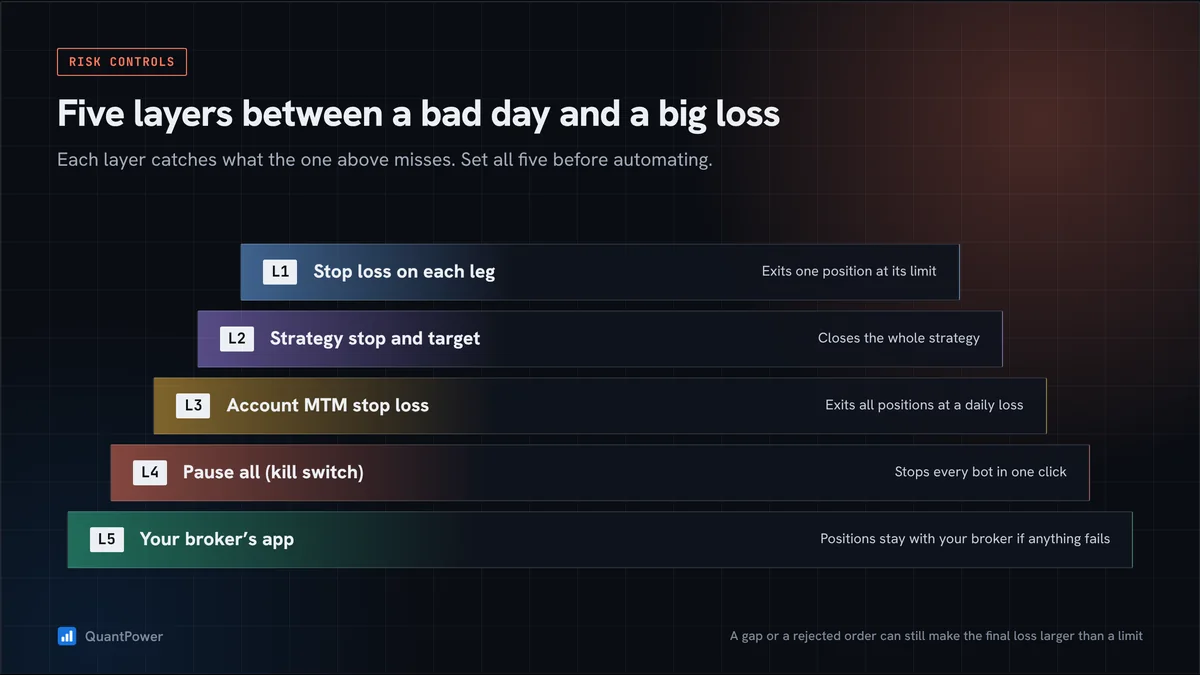
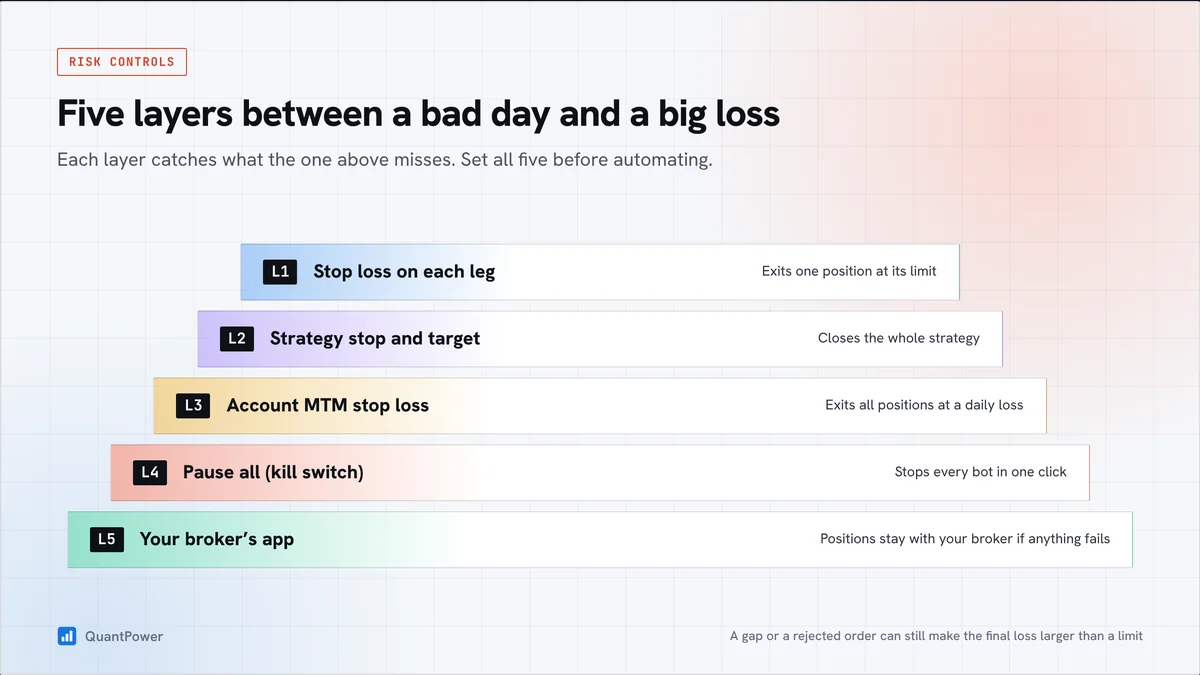
Decide three numbers before the first trade: the capital you can afford to lose entirely while learning, the most one trade may lose, and a daily loss limit. For example, with ₹5 lakh: ₹10,000 a trade at 2%, and no new trades after a ₹15,000 loss in a day. Write them down, because rules on paper are harder to bend in the middle of a session.
Step 4. Forward test for several weeks
Trade on live prices with test money until the mechanics are routine: placing limit orders, watching decay, exiting on your rules. The section on forward testing below lists what to practise.
Step 5. Place a first trade with a known worst case
Use one lot of a structure whose maximum loss is the price you pay: a bought call or put, or a debit spread. The worked trade below shows the full plan.
Step 6. Record and review every trade
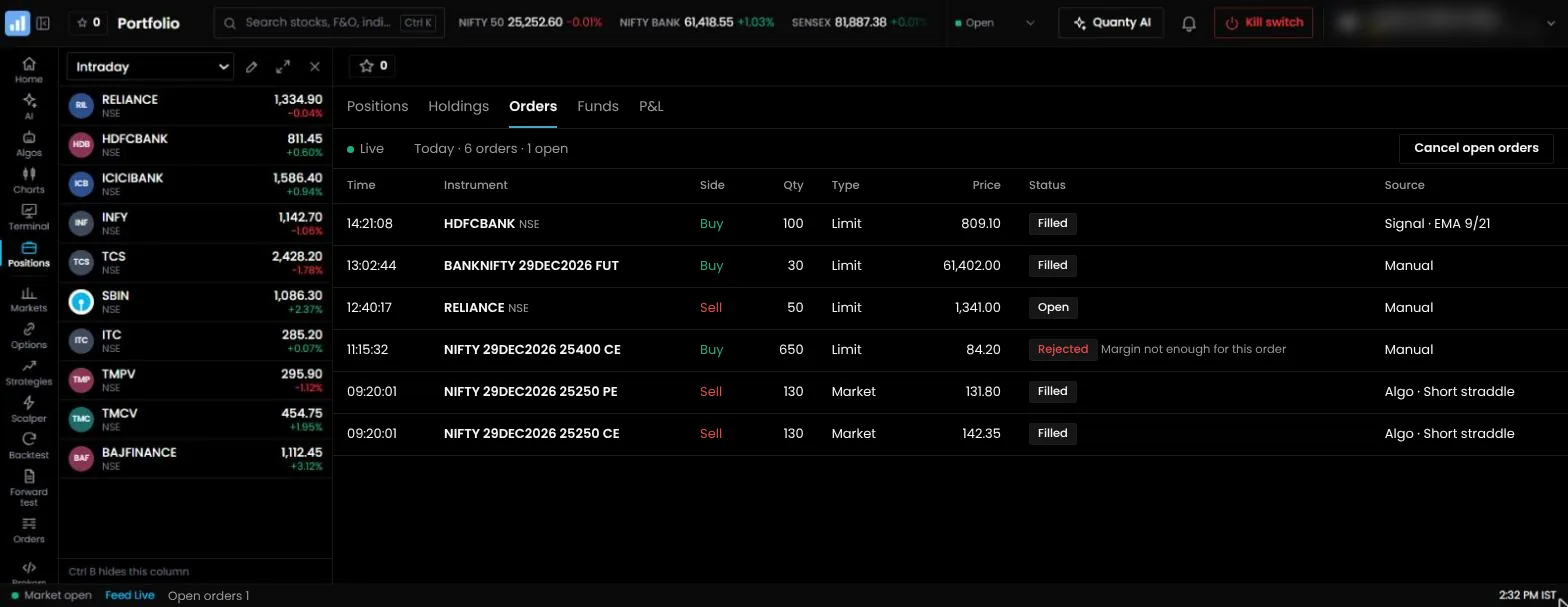
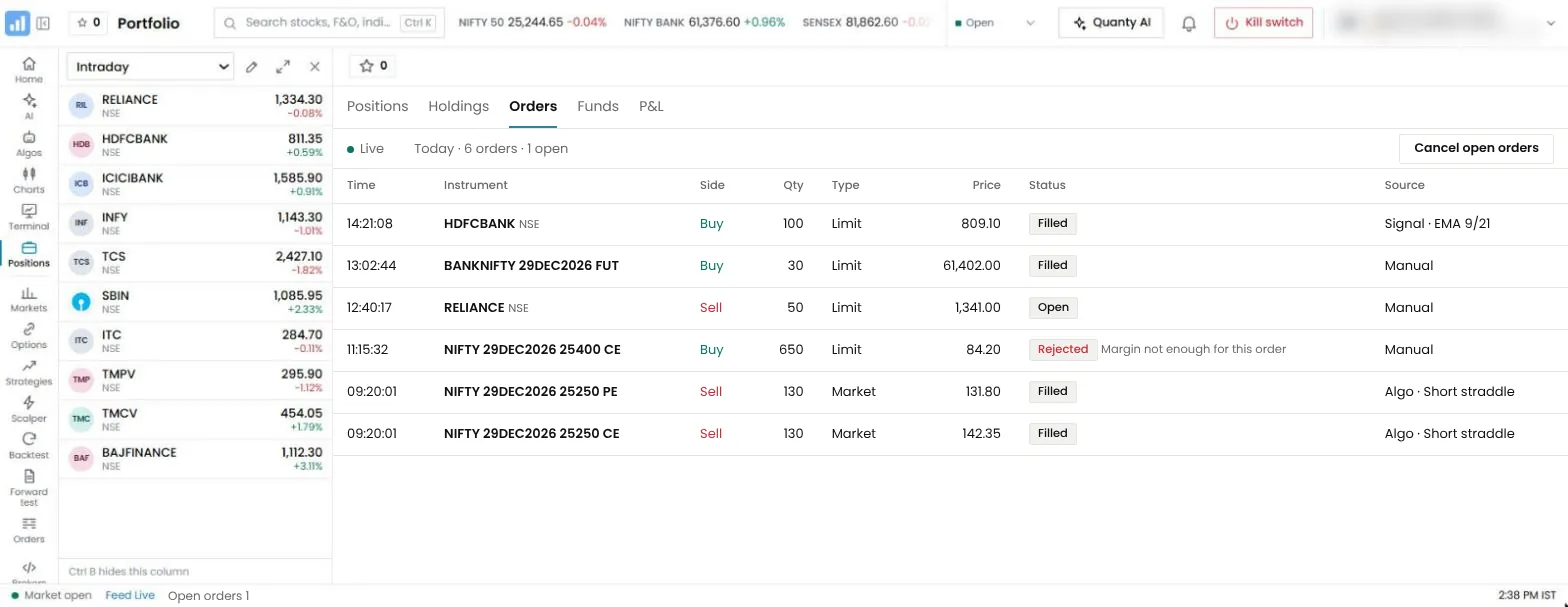
Keep a journal with the plan, the fills, the exit and whether you followed the rules. Review it every weekend.
Step 7. Grow slowly, and automate the rules that work
Add size or a new structure only after a month in which every trade followed the plan. Rules that hold up can be backtested and run automatically, which keeps them consistent; see the section on automation below.
Your first trade, step by step
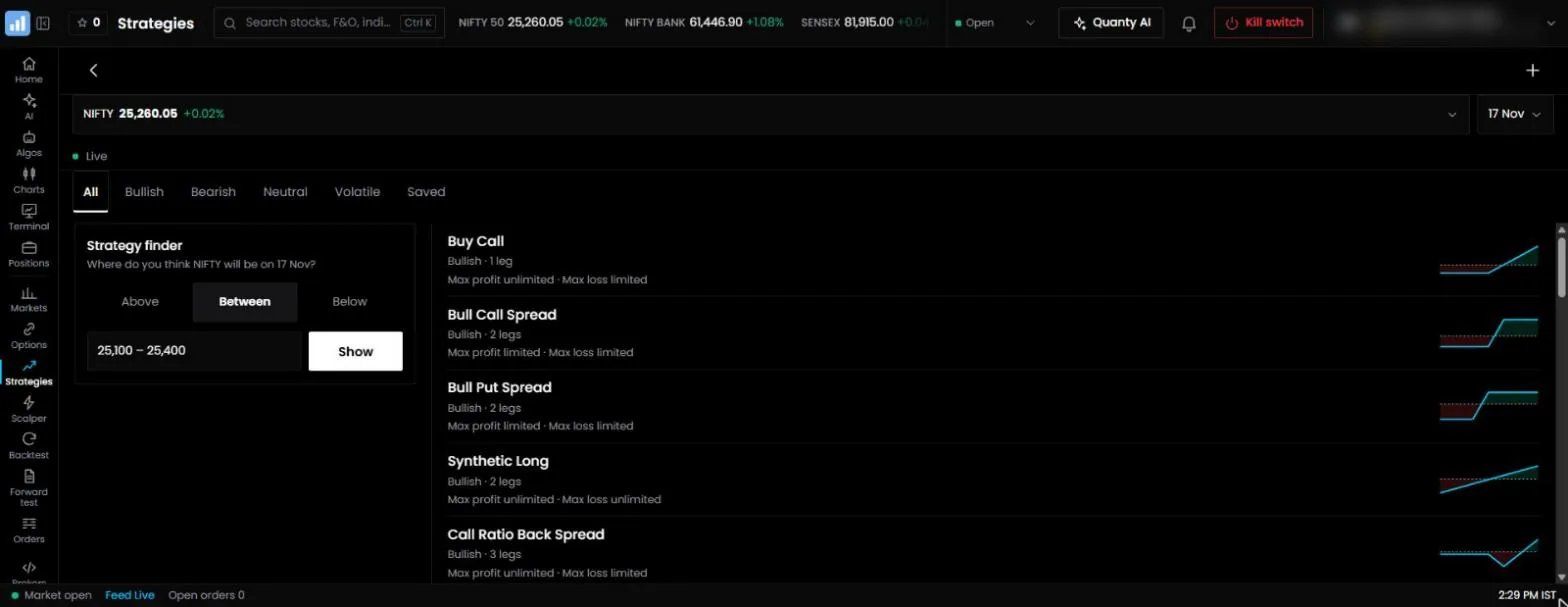
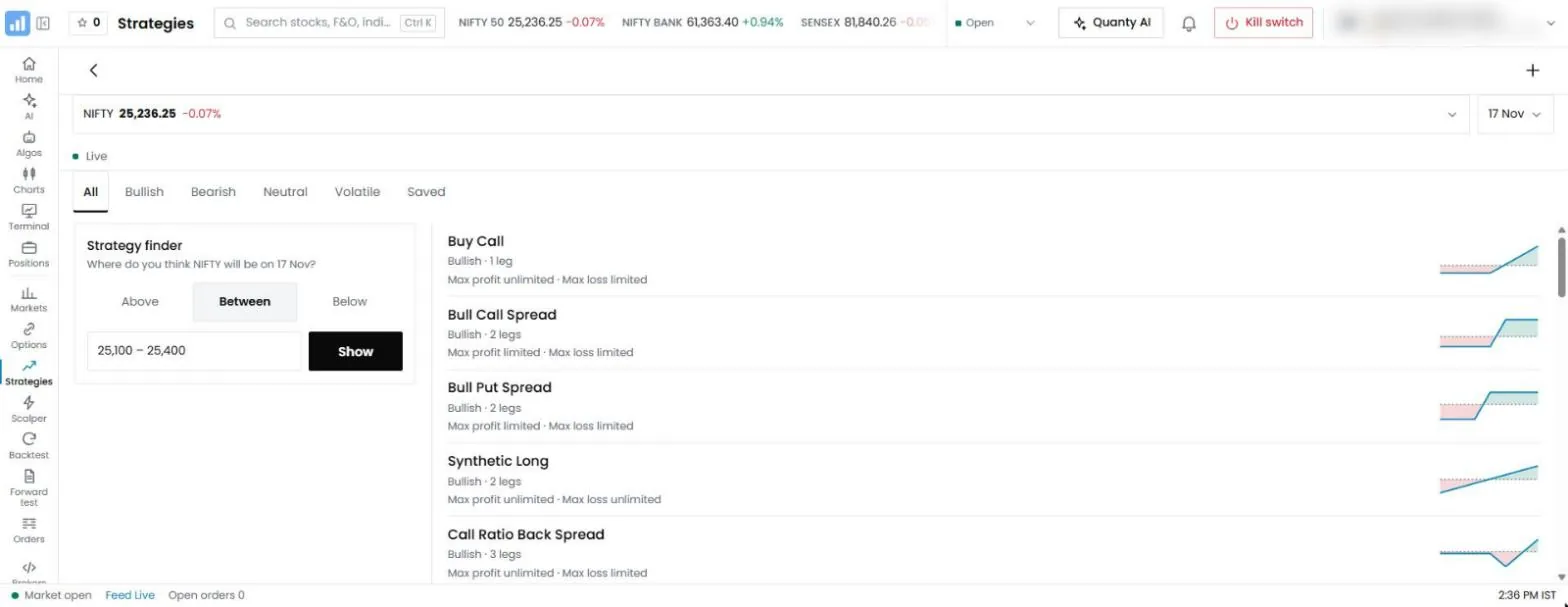
Here is how a beginner might plan a first defined-risk trade, using the bull call spread from the table. The figures are model estimates.
- The view. Nifty is at 25,000, and you expect a moderate rise over the next week, not a sharp rally.
- The structure. Buy the 25,000 call at ₹280.48 and sell the 25,300 call at ₹150.11, same weekly expiry. Net cost: ₹130.37 a unit, or ₹8,474 a lot.
- The numbers before you trade. Maximum loss ₹8,474. Maximum profit ₹11,026, if Nifty is at or above 25,300 at expiry. Break-even 25,130 at expiry.
- The exit plan. Take profit at +₹4,000, cut the loss at −₹3,000, and close after five days if neither has happened.
- The size. One lot. The planned loss of ₹3,000 is under 1% of a ₹5 lakh account, and the maximum of ₹8,474 is under 2%.
- The check. Build it in the options profit calculator and confirm that the payoff matches the view.
- The orders. Place the bought leg first, then the sold leg, both as limit orders near the middle of the bid and ask.
Five days later, with seven days left and IV unchanged:
| Nifty after five days | 25,000 call | 25,300 call | Spread value | P&L per lot | What the plan does |
|---|---|---|---|---|---|
| 25,200 | ₹331.10 | ₹162.84 | ₹168.26 | +₹2,463 | Time exit: close for about +₹2,295 after charges |
| 25,000 | ₹209.21 | ₹88.94 | ₹120.27 | −₹657 | Time exit: close for about −₹807 after charges |
| 24,800 | ₹119.71 | ₹43.18 | ₹76.53 | −₹3,500 | The stop at −₹3,000 has already closed it |
The spread moves gently. Both legs lose time value, so the decay partly cancels: with Nifty unchanged after five days, the spread is down ₹657, while the 25,000 call on its own would be down ₹4,633. That makes spreads easier to manage while you learn how prices behave. In the third row the stop was hit before day five. Had Nifty gapped below the stop level overnight, the loss would have been larger than ₹3,000, but never more than ₹8,474.
Practise on paper before real money
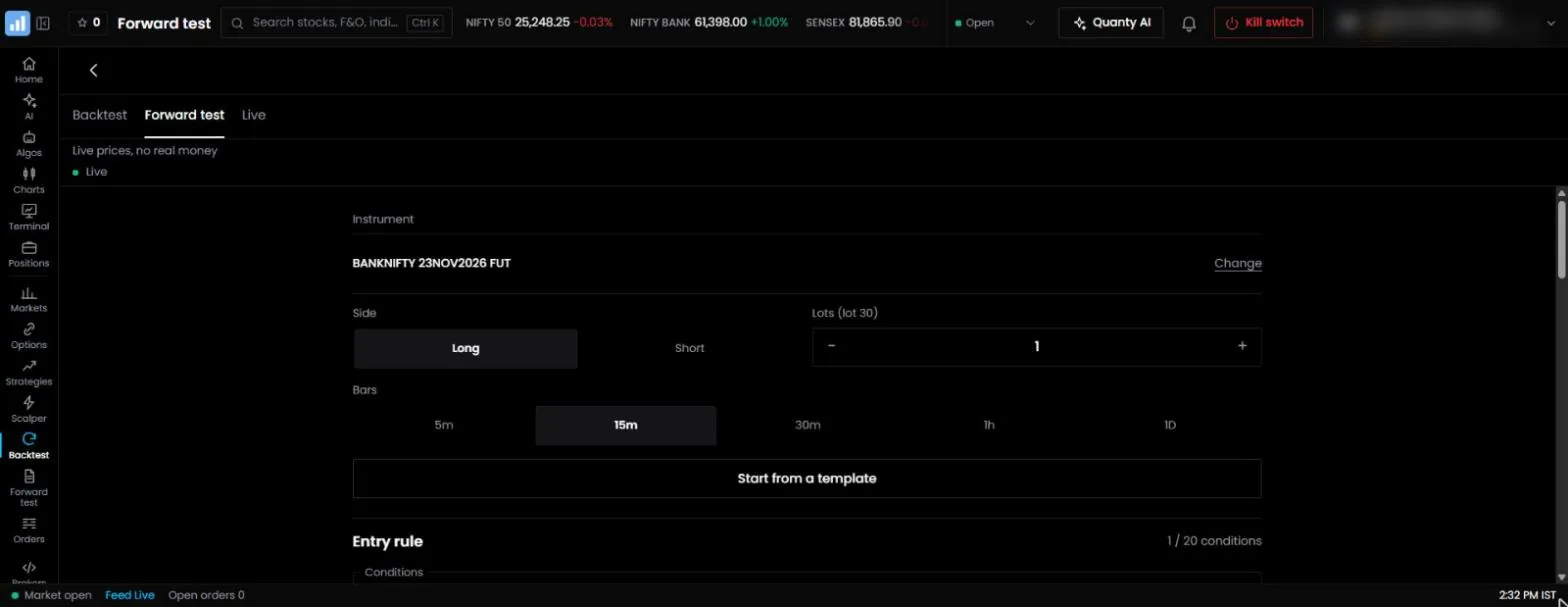
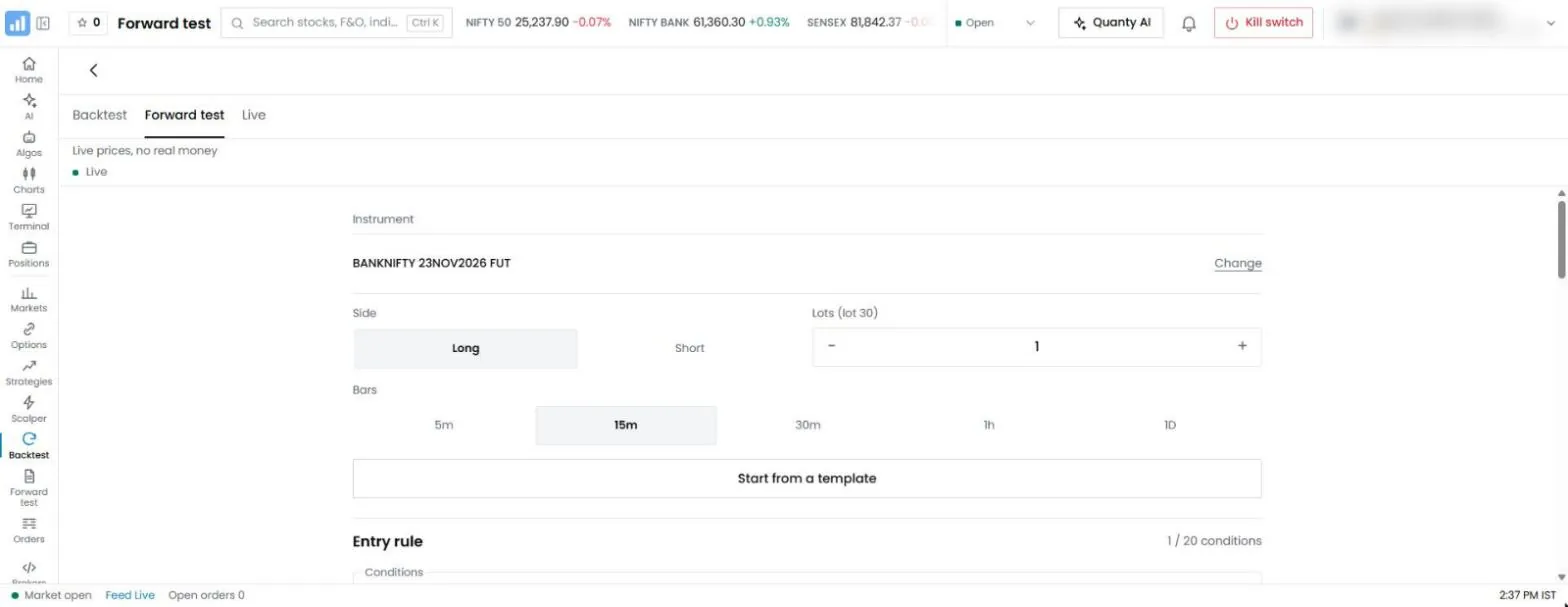
Forward testing runs your trades on live prices with test money. Spend at least a few weeks on these:
- Reading the option chain for your expiry: find the at-the-money strike, compare the bid and ask, and see how premiums change across strikes.
- Placing limit orders at the bid, the ask and the middle, and noting which fill.
- Watching time decay on a position held several days with the index flat.
- Watching IV before and after a scheduled event, such as an RBI policy decision.
- Exiting on your rules, including the time exit, even when it feels early.
- Recording every trade in the journal, with the reason for the entry and the exit.
Forward testing has limits. Simulated fills can be kinder than real ones in a fast market, and a virtual loss does not test your discipline the way a real one does. Use the prices you would really get, usually the bid when selling and the ask when buying, and expect your first real trades to fill a little worse.
How to learn option trading: a 12-week plan
Twelve weeks is enough to go from the basics to small live trades, if each stage passes its check before the next one begins:
| Weeks | Focus | Practice | Move on when |
|---|---|---|---|
| 1 to 2 | The contract, calls and puts, premium and lot maths | Read the option chain every day; work out the cost, maximum loss and break-even of five options | You can do it for any single option in under a minute |
| 3 to 4 | Time decay and IV | Forward test single calls and puts; note their value every day | You can explain why a position lost money on a flat day |
| 5 to 6 | Debit spreads | Forward test bull call and bear put spreads with a written plan | Every forward test had an entry, a target, a stop and a time exit |
| 7 to 8 | Credit spreads and margin | Forward test one credit spread; note the margin it would block | You know the margin and the maximum loss before the order |
| 9 to 10 | First live trades | One lot of a debit spread, with the same rules as on paper | Losses stayed within plan and the journal is complete |
| 11 to 12 | Review | Compare live results with paper results; change one rule at most | Every trade followed the rules for four weeks |
If a stage does not pass its check, repeat it. Free material is enough for every stage: the exchanges' contract specifications, our guides, and forward testing for practice. The order of the stages and an honest journal matter more than any course.
How time and volatility move a bought option
Bought options lose value as expiry approaches, and the loss speeds up at the end. In the model, with Nifty unchanged at 25,000 and IV of 14%, the 25,000 call is worth:
| Days to expiry | Call value per unit | Per lot of 65 |
|---|---|---|
| 30 | ₹469.35 | ₹30,508 |
| 12 | ₹280.48 | ₹18,231 |
| 5 | ₹174.72 | ₹11,357 |
| 2 | ₹107.85 | ₹7,010 |
| 1 | ₹75.33 | ₹4,896 |

Buyers should therefore choose expiries with enough time for the view to play out, and close a trade that has not moved instead of waiting for it. Volatility is the second force. IV rises before scheduled events, such as RBI policy, the Union Budget and election results, and usually falls once the news is out, so an option bought the day before can lose value even when the index moves the right way. Until you have watched this happen in a forward test, avoid opening new positions just before events.
Buying or selling: which to learn first?
Learn buying first. Bought options and debit spreads have a known maximum loss, so mistakes are survivable while you learn how premiums, time decay and IV behave. Selling options can lose many times the premium, needs margin and demands fast, disciplined exits; the sold put in the table above collects ₹14,762 and loses ₹50,238 on a 1,000-point fall. Move to selling only with hedged structures, such as credit spreads and iron condors, after your rules and records are consistent.
Risk rules for the first year
These rules are a starting set. Write your own numbers into each, and keep them for the first year:
- Risk a fixed share per trade, such as 1% to 2% of the account, measured from the stop and checked against the maximum loss.
- Set a daily loss limit, such as 3%, and stop trading for the day when it is reached.
- Set a monthly loss limit, such as 6%, and pause for a review when it is reached.
- Never add to a losing option to average down.
- Do not sell naked options until you have traded hedged structures through several volatile weeks.
- Avoid opening positions just before scheduled events until you have seen how IV behaves around them.
- Cap the number of trades, such as two or three a week in the first months.
- Know how stops work for options. NSE discontinued stop-loss market (SL-M) orders in index and stock options in 2021, so stops are placed as stop-loss limit orders.4 In a fast market the price can jump past the limit and leave the order unfilled, so watch every stop, or use a platform that monitors it for you.
Charges and tax on a first trade
Every options trade pays brokerage, securities transaction tax (STT), exchange transaction charges, the SEBI fee, stamp duty and GST, plus the gap between the bid and the ask.5 For the first trade above, closed at 25,200 after five days, at ₹20 brokerage per order:
| Charge | How it is worked out | Amount |
|---|---|---|
| Brokerage | 4 orders at ₹20 | ₹80.00 |
| STT | 0.15% of the ₹31,279 sold | ₹46.92 |
| Exchange transaction charges | 0.0355% of the ₹60,094 traded | ₹21.33 |
| SEBI fee | ₹10 per crore traded | ₹0.06 |
| Stamp duty | 0.003% of the ₹28,816 bought | ₹0.86 |
| GST | 18% of brokerage, exchange charges and the SEBI fee | ₹18.25 |
| Total | About ₹167 |
On one trade that is small: about 7% of the ₹2,463 gross profit. Frequent trading changes the picture. Twenty spread trades a month at about ₹160 each cost about ₹3,200 before slippage, which is why a trade cap belongs in the plan. Try your own numbers below.
Brokerage, STT, exchange charges, SEBI fee, stamp duty and GST for one round trip, by broker.
In India, profits and losses from F&O trading are generally treated as non-speculative business income, and a tax audit may be required above certain turnover levels. Keep records of every trade and confirm your position with a tax professional.
Choosing a broker and a platform
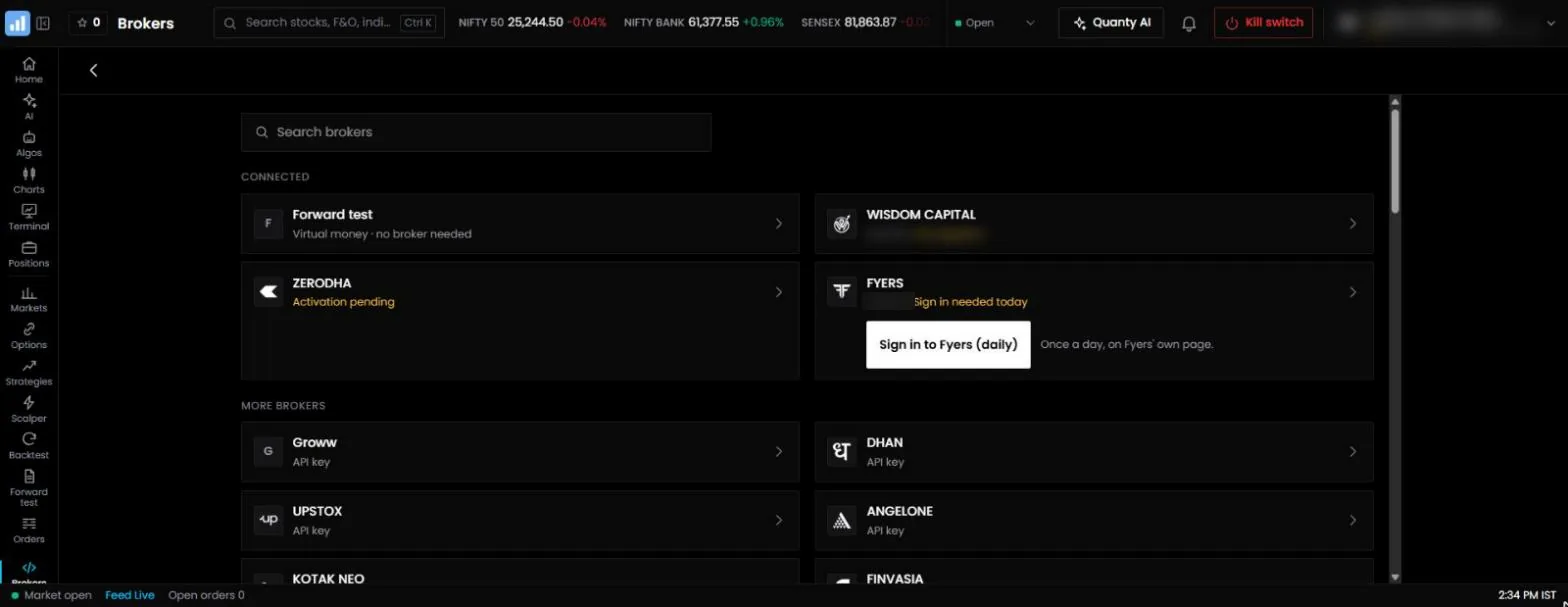
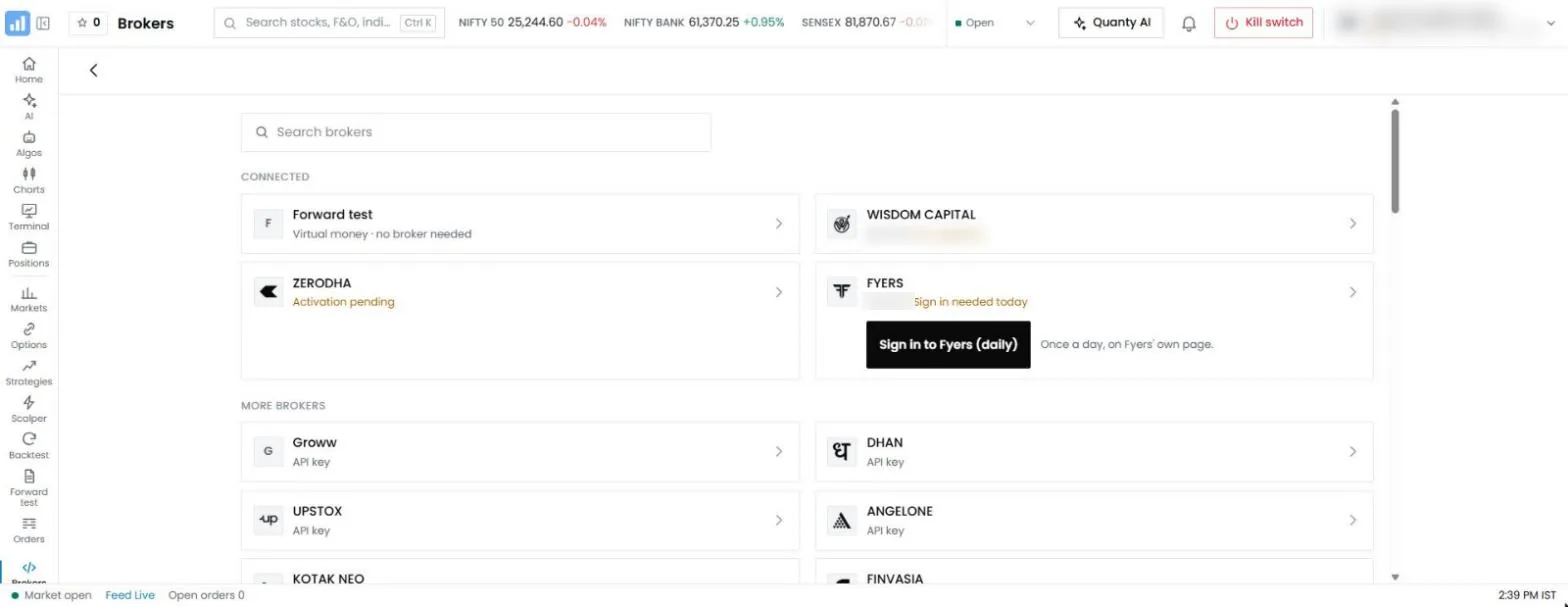
Look for:
- F&O access with clear activation steps.
- Reliable order placement during busy sessions, including expiry days.
- Clear charges for brokerage and other fees; compare them with the brokerage calculator.
- Good tools: an option chain with OI and IV, a payoff view and an order book.
- Forward testing or a simulator to practise.
- Risk controls such as stop orders and a daily loss limit.
QuantPower's options trading platform connects 100+ Indian brokers, including Wisdom Capital, Zerodha, Upstox, Fyers and IIFL Capital, and adds an option chain, a strategy builder, backtesting and forward testing on top of your broker account. Your money and positions stay with your broker.
Common beginner mistakes
- Buying far out-of-the-money options because they are cheap. The 25,500 call costs ₹5,987 a lot, and the model gives it a 17% chance of finishing above its break-even.
- Holding a losing option to expiry in the hope of a turnaround, while time decay takes more of it every day.
- Trading on expiry day without understanding how fast premiums move in the final hours.
- Buying options before events when IV is high, then losing to the fall in IV afterwards.
- Selling options without a hedge or a stop because they usually expire worthless. The sold 25,000 put loses ₹17,738 if Nifty ends at 24,500, more than its full credit.
- Sizing from the premium instead of the loss. A cheap premium does not make a position small: one Nifty lot controls ₹16.25 lakh of index.
- Overtrading after a loss to win it back the same day.
- Following tips without knowing the maximum loss, the break-even and the exit.
Questions to ask before every trade
- What is my view, and what would prove it wrong?
- What is the most I can lose, and is it within my limit?
- What is the break-even, and how far is it from the index?
- Is IV high or low, and is an event due before expiry?
- When will I exit if nothing happens?
- Am I trading because of my plan, or because I want to make back a loss?
How to measure your progress
After each month, check:
- Rules followed: the share of trades that kept to the plan. This is the first number to get to 100%.
- Expectancy: the average result per trade after charges.
- Average loss against plan: whether losses stay within the planned risk.
- Largest drawdown of the month, against your monthly limit.
Progress means following your rules consistently. Profits come later, and only if the rules have an edge.
Signs you are ready for real money
- You have forward-tested for several weeks and followed your rules on every trade.
- You can state the maximum loss, break-even and exit plan of a trade before placing it.
- Your journal shows losses staying within your planned risk.
- You have a daily loss limit and have stopped when it was reached.
- You know how much margin your broker would block for a hedged sale, even if you are not selling yet.
Start with one lot, and keep the rules you used on paper.
When to stop and reassess
Pause trading and review the journal if:
- You break your own rules twice in a week.
- You hit your monthly loss limit.
- Your live results are far worse than your paper results.
- You notice that you are trading to recover losses rather than on your plan.
A pause is part of the plan. Write the conditions for it down with the other rules, before you need them.
Where automation helps beginners
Many beginner mistakes come from emotion: holding losers, moving stops, trading too often. Rules run by software are followed every time. QuantPower's strategy builder lets you set entries, strikes, stops, targets and time exits without code, test the rules with backtesting on historical data and practise them in a forward test before going live. Smart Exit squares off every position when the day's loss reaches the amount you set, and the daily loss limit then refuses new orders.
Automated strategies run on your own broker account. Under SEBI's framework for retail algorithmic trading, in full effect since 1 April 2026, every automated order carries an exchange-assigned Algo ID.6
Start with 500 free tokens
Connect your broker, build a strategy and test it on paper before a single live order goes out.
Where options trading for beginners is going
The direction of the rules is to make the first trades harder to get wrong: larger contracts mean a beginner cannot start as small as before, brokers show the SEBI risk disclosure before an account trades F&O, and every automated order now carries an Algo ID. Learning tools have moved the other way and become easier to reach. A beginner can now read model prices, test a rule on past data and run it in forward test on live prices before a rupee is at risk, and AI assistants can explain a chain or a payoff in plain words. Neither change alters the core of this guide: start with trades whose worst case you know, keep a journal, and let your results, not your excitement, decide when to add size.
Frequently asked questions
Is options trading good for beginners?
It can be learned, but most new traders lose money: SEBI found that 87.7% of individual traders in equity derivatives made net losses in FY26. Options trading suits beginners who treat the first months as learning: forward testing first, only structures with a known maximum loss, size set from that loss, and a journal of every trade.
Can I start option trading with ₹10,000?
You can place a trade. One lot of the 25,300 Nifty call 12 days before expiry costs about ₹9,757 in the model, and the 25,000/25,300 bull call spread about ₹8,474. But one trade would put most of the account at risk. At a 2% risk rule, that spread fits an account of about ₹4.2 lakh. With ₹10,000, forward testing teaches the same lessons without the loss.
Can I learn option trading for free?
Yes. NSE and BSE publish contract specifications and investor education material, our guides are free, and forward testing lets you practise on live prices without money. A paid course adds structure; the 12-week plan above gives the same structure, and the journal shows whether you are improving.
How long does it take to learn options trading?
Plan on at least three months before trading real money with consistent rules: about eight weeks of study and forward testing, then small live trades with the same rules. Some stages take longer. Move on when your journal passes each stage's check.
Which kind of option trade should a beginner start with?
Start with buying and with debit spreads, where the most you can lose is what you pay. Selling wins more often but can lose many times the premium: in the model, the sold 25,000 put collects ₹14,762 and loses ₹50,238 if Nifty ends 1,000 points lower. Move to hedged selling, such as credit spreads, after your rules and records are consistent.
How many trades should a beginner place?
Few enough that every trade is planned and reviewed. A cap of two or three trades a week in the first months keeps the journal useful and the charges small: 20 spread trades a month at about ₹160 each cost about ₹3,200 before slippage.
What should a beginner do after a big loss?
Stop trading for the day; that is what the daily loss limit is for. Then review the trade in the journal: was it inside the plan, was the size right, was the exit followed? Return at the same or a smaller size, and do not add trades to win the loss back.
Related guides and terms
- Options trading: calls, puts and contracts explained
- Options trading strategies: the main strategies by market view
- Option buying vs selling: the trade-off between the two sides
- Option greeks: what moves an option's price
References
- SEBI, Profitability of Individual Traders in the Equity Derivatives Segment (FY25–FY26), PR No. 50/2026, 20 August 2026
- SEBI circular SEBI/HO/MRD/TPD-1/P/CIR/2024/132: Measures to strengthen the equity index derivatives framework, 1 Oct 2024
- NSE: Equity derivatives contract specifications (lot sizes, expiry days and settlement)
- NSE circular NSE/FAOP/49677: SL-M orders discontinued in index and stock options from 27 September 2021
- Finance Act, 2026: STT of 0.15% on the sale of options from 1 April 2026
- SEBI circular on safer participation of retail investors in algorithmic trading, 4 Feb 2025, and the implementation timeline to 1 April 2026
- Black, F. and Scholes, M. (1973). The Pricing of Options and Corporate Liabilities. Journal of Political Economy, 81(3), 637–654
- SEBI: study of individual traders in equity F&O for FY22, January 2023, and press release PR No. 22/2024 on FY22 to FY24, 23 September 2024 (sebi.gov.in)